2026-10-17
Choosing an ACU teaching age group: early childhood, primary or secondary
Start an ACU teaching-course comparison with the learners you want to teach: early childhood, primary, secondary or a pathway covering two sectors.
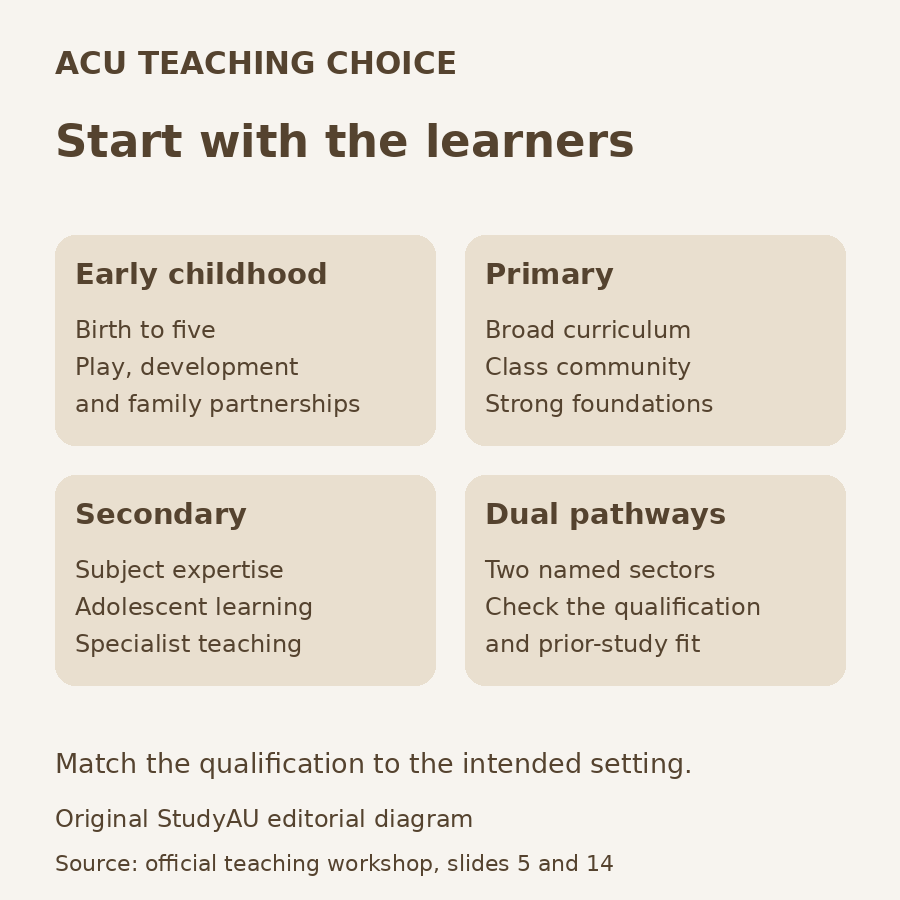
Choosing an ACU teaching course starts with the learners you want to teach. Early childhood, primary and secondary education involve different interests and different qualification choices. A course spanning two sectors also needs to name the two settings you intend to work in.
ACU’s official 2026 teaching workshop provides a useful starting comparison. Use it to identify the kind of teaching that appeals to you, then match that preference to a specific qualification. The age group and the award need to fit each other.
Compare the teaching focus
Early childhood centres on birth-to-five learning. The workshop emphasises development, play, relationships and partnerships with families. Consider whether helping young children learn through those relationships appeals to you, rather than choosing the field simply because the learners are young.
Primary centres on breadth across the curriculum, building foundations and working with a class community. It is worth considering if you want to engage with several areas of children’s learning. Enjoying one subject can be part of that interest, but a single subject is not the whole focus described in the workshop.
Secondary brings subject expertise together with adolescent learning and specialist teaching. Ask both whether you want to work with this age group and which discipline you want to teach. Strong interest in a subject does not, by itself, establish that your previous study meets a graduate-entry teaching-area requirement.
Dual-sector study can suit an interest in two settings. However, early childhood–primary and primary–secondary are different combinations. Neither label means preparation for every age group and every school subject.
Translate that preference into a course shortlist
The workshop names five undergraduate course families for 2027. The useful comparison is the setting covered by the award, rather than how broad its title sounds:
- Bachelor of Early Childhood Education (Birth to Five Years): focus on early childhood. ACU’s 2027 handbook explicitly says the qualification does not permit graduates to teach in Australian primary or secondary schools. See the Birth-to-Five course guide for its course-specific scope.
- Bachelor of Education (Early Childhood and Primary): compare this if your interest spans early learning and primary education. The early childhood and primary guide explains this combination separately from the Birth-to-Five award.
- Bachelor of Education (Primary): compare this when primary teaching is the intended setting. The primary course guide examines the curriculum and course-specific requirements.
- Bachelor of Education (Primary and Secondary): combines primary curriculum breadth with one specialist secondary teaching area, as described on ACU’s course page. The primary and secondary guide explains why this is a different choice from primary alone.
- Bachelor of Education (Secondary): compare this for specialist subject teaching with adolescents. The secondary course guide covers teaching-area structure and its limitations.
These are academic comparisons, not a list of courses available to every international applicant at every campus. Location, intake, prior-study and other course restrictions still need checking for your application. A general campus list or a course appearing in the workshop is not a personal offer.
Test the difference with two decisions
If you enjoy supporting young children and families, distinguish an interest in prior-to-school learning from an interest that also includes primary classrooms. That distinction helps you compare Birth-to-Five with early childhood and primary, rather than treating “early childhood” in both titles as the same qualification scope.
If you enjoy a broad class curriculum but also want to teach a particular secondary subject, compare primary with primary and secondary. Check the secondary specialism in the latter course. A broader age range does not remove the need to choose an appropriate subject area.
These examples are reflection prompts based on the workshop’s comparison, rather than ACU selection tests or predictions of which teaching job will suit you.
Then check your entry route and practical readiness
After identifying the intended learners, consider your existing qualifications. The workshop contrasts undergraduate teacher-education pathways with graduate-entry Master of Teaching pathways where an existing bachelor’s degree meets the relevant requirements. Holding a degree does not make every teaching area available, and a shorter course is useful only if its teaching scope fits your goal.
For an existing degree holder, the separate guides to early childhood and primary, primary and secondary Master of Teaching courses provide a more specific next step. A Master of Education has a different purpose; see the Master of Education and Master of Teaching comparison.
Finally, check the exact course’s admission and English requirements, professional experience and required checks. For a school-teaching goal, also distinguish course admission and completion from the requirements for registration. Do not apply a blanket school-teaching or testing rule to the Birth-to-Five-only award.
A useful shortlist therefore records three things together: the learners you want to teach, the qualification that covers that setting, and whether your background and intended intake fit its requirements. It supports a course decision; it does not guarantee registration, employment or a migration outcome.
Sources: ACU’s official 2026 teaching workshop, slides 5–7 and 14; the 2027 Birth-to-Five handbook; and the primary and secondary course page. Course-specific source checks and limitations are explained in the linked guides.