2026-10-17
ACU Early Childhood and Primary BEd: One Degree Across Two Sectors
ACU’s Early Childhood and Primary degree covers two education sectors within one Bachelor of Education. Understand its age range, learning settings and international campus scope.
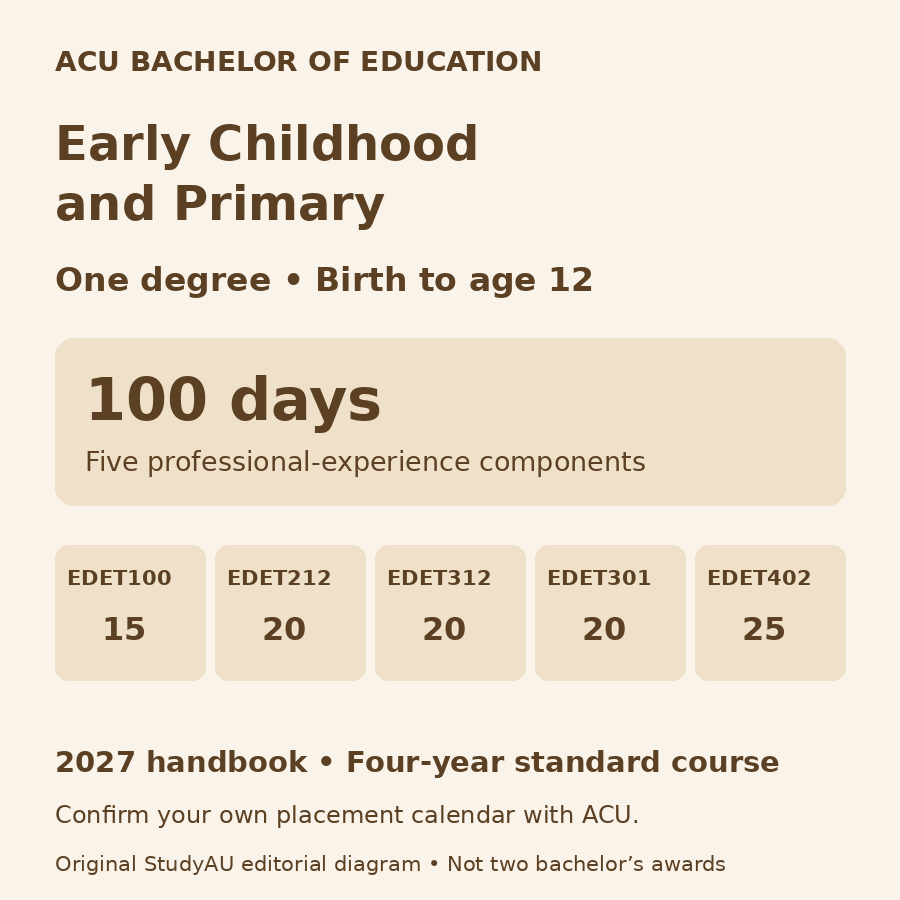
ACU’s Bachelor of Education (Early Childhood and Primary) is one degree covering two education sectors. It is not a double degree awarding two separate bachelor's qualifications. The course is relevant to applicants who want to consider both early-childhood education and primary-school teaching rather than limit their course search to one setting.
The qualification appears in ACU’s teaching workshop list of undergraduate pathways for 2027. The international course information describes a four-year full-time structure, or equivalent part-time duration, with a teaching focus from birth to age 12. ACU international course information
What does the broader age range cover?
The course information identifies childcare, kindergarten, preschool and primary-school settings. The breadth is therefore about working across early childhood and primary education, not about being qualified for every school age group.
This distinction is useful when comparing it with ACU’s Birth to Five degree. That is a separately named early-childhood qualification, whereas Early Childhood and Primary explicitly includes the primary sector. The names should not be shortened until that difference disappears.
For an applicant, a useful reflection is whether both kinds of setting appeal to you. A broader course is not automatically a better fit if your interests are firmly in one sector. That is a question about your aims, not an extra entry condition imposed by ACU.
One degree can include a teaching specialisation
The course information lists teaching specialisations in literacy, numeracy or religious education. These provide a focus within the Bachelor of Education; they do not turn it into two bachelor's awards or a general secondary-teaching qualification.
When examining the course plan, check how the relevant specialisation fits the units and options available to your cohort. Do not assume that a named specialisation can be added to any other education degree, or that every option is interchangeable across courses.
Professional experience spans both sectors
The 2027 handbook specifies a 320-credit-point degree. Its professional-experience components are listed in five units:
| Unit | Days |
|---|---|
| EDET100 | 15 |
| EDET212 | 20 |
| EDET312 | 20 |
| EDET301 | 20 |
| EDET402 | 25 |
These components total 100 days. ACU’s course page describes experience across early-childhood and primary settings. The unit total does not establish an individual placement calendar or allocation. 2027 handbook unit requirements, course placement information
Before arranging work or travel, obtain the schedule for this course and cohort. Its requirements differ from those of a Birth-to-Five-only award or the graduate-entry teaching master's. Ask about preparation, attendance and travel for the assigned blocks rather than borrowing another course’s timetable.
International campus information is course-specific
The 2027 international course information lists Melbourne and Strathfield. This is more relevant to an international applicant than a general map of all ACU campuses or the domestic availability of another teaching degree.
The handbook’s broader approved-location list excludes international intakes at Ballarat, Blacktown, Canberra and North Sydney. It should not be used to infer that every other listed location has an available international intake. Confirm your course, campus and commencement together. 2027 handbook location notes
Likewise, the stated full-time and equivalent part-time structures do not by themselves establish which enrolment arrangement is available to an individual international applicant. Confirm the course, campus, intake and applicable conditions together before relying on an option.
The final distinction is between course preparation and professional registration. Studying a degree that spans early childhood and primary does not automatically complete every registration or employment requirement. The qualification's scope, the student's successful completion and any professional conditions need separate attention.
Sources: ACU’s official teaching workshop, slides 5–7 and 10, and the named international course and 2027 handbook sections checked on 17 October 2026.