2026-10-17
ACU Secondary Education Bachelor: First and Second Teaching Areas
Use your subject interests to investigate ACU’s Secondary Education degree, while checking approved teaching areas, course options and campus-specific availability.
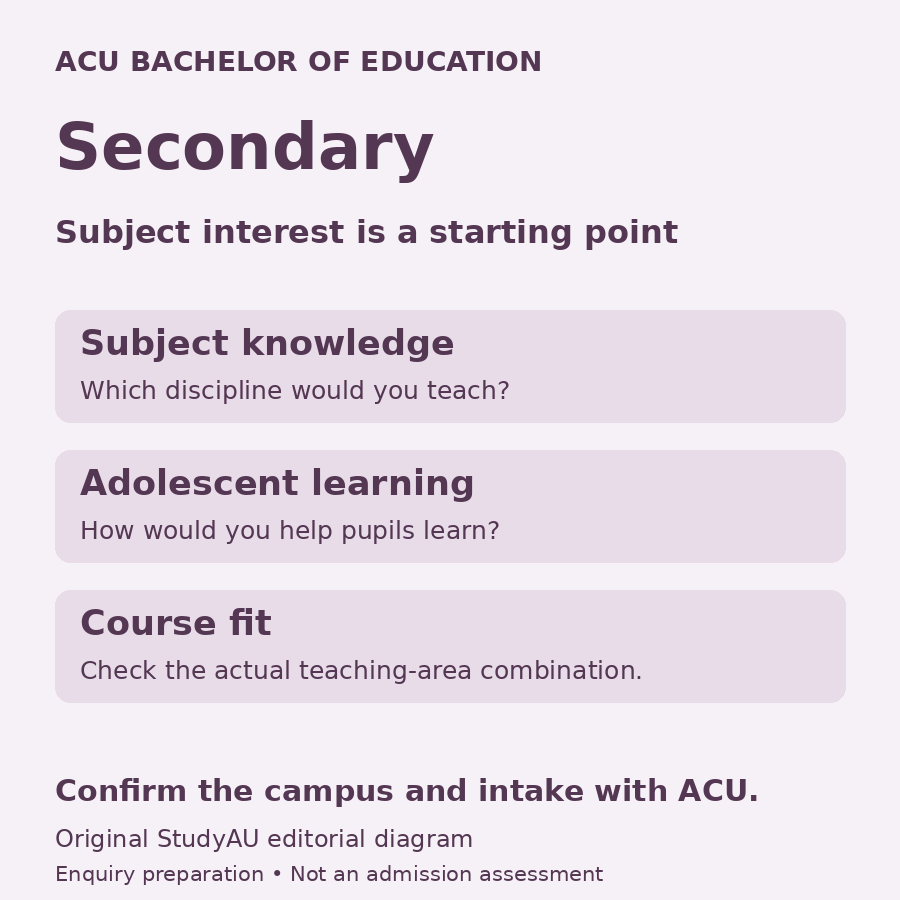
Which subject would you like to help secondary-school students understand? ACU’s teaching workshop uses subject interest as the starting point for exploring secondary education. It also describes secondary teaching through adolescent learning and specialist teaching, so enjoying the discipline is only part of the decision.
The Bachelor of Education (Secondary) is a named undergraduate pathway in that workshop. Its 2027 handbook describes a four-year, 320-credit-point degree. The next step is to connect your subject interests with the teaching areas and course structure actually available to you. ACU 2027 Secondary handbook
Treat the workshop’s subject list as a starting map
The secondary-pathways slide names English, Mathematics, Sciences, Humanities, Arts, HPE and Technologies as teaching areas. These are broad areas across the pathways presented, not a guarantee that every subject or combination is offered within this single degree at every campus.
This matters particularly when a broad label contains several possible disciplines. A reference to Sciences, for example, does not by itself confirm the exact science teaching area you want. Ask about the named area, the degree and the campus together.
As a practical preparation step, write down your preferred subject, any alternative you would seriously consider, and why you want to teach it to adolescents. That is a general way to make a course enquiry more focused, not an ACU application requirement.
Check how the teaching areas fit within the degree
The 2027 Secondary course rules distinguish between a first and second teaching area, and a first teaching area combined with a Special Education major. These are course-structure alternatives, not permission to add any combination of subjects without checking the rules.
The handbook defines the ordinary teaching areas as follows:
| Teaching area | Prescribed study |
|---|---|
| First | 80 credit points: 6 subject-content units and 2 corresponding curriculum units. |
| Second | 60 credit points: 4 subject-content units and 2 corresponding curriculum units. |
The first area draws content from a relevant major; the second can draw from a relevant major or minor. They require the prescribed units and relevant jurisdictional recognition. These groups sit within the wider 320-credit-point course, rather than forming the whole degree by themselves. Handbook teaching-area definitions
The alternative Special Education structure contains an 80-credit-point first teaching area and an 80-credit-point named major. It is not another bachelor's award or an automatic addition to two existing teaching areas. Handbook course structures
For international applicants, the 2027 major handbook explicitly says the major is not available. A course-structure table does not establish an exception. Address that restriction with ACU before planning around the major if other information you receive appears different. This is a major-specific issue, not a claim that the whole Secondary degree excludes international applicants.
The named major is also distinct from the broader inclusion content involved in teacher preparation. They should not be treated as interchangeable descriptions of the same study choice.
Keep the single degree and double degrees distinct
ACU’s workshop lists Bachelor of Education (Secondary) alongside separate double degrees with Arts, Exercise Science, and Arts (Design Innovation and Technologies). Their presence on the same slide does not mean their disciplinary options, campus availability or professional-experience arrangements can be transferred into the single BEd.
Compare the exact award that supports your intended teaching area. A student investigating a technology-focused double degree, for instance, should not assume that its course structure applies to Bachelor of Education (Secondary). Likewise, a general Arts subject list does not settle the permitted teaching combinations in this degree.
Make the enquiry specific before choosing a campus
A useful enquiry should identify the exact course, desired teaching areas, intended year of entry, and whether you are an international applicant. If your enquiry concerns Special Education, address the handbook restriction first rather than treating the major as an available alternative. Then ask which eligible combinations are offered for that campus and intake, and what academic and English entry requirements apply.
For 2027, the handbook says Ballarat and Blacktown are not offered, and Brisbane and Canberra have no international intakes. It reserves the Online location for an employment-based pathway. Do not read that listing as a standard offshore online offer. Handbook location notes
The workshop separately warns that university-entry English and teacher-registration English requirements can differ. Admission, completion of the degree and professional registration are distinct stages. Choosing a teaching area or completing the course does not guarantee a particular teaching appointment.
Sources: ACU’s official teaching workshop, slides 5, 8 and 13; named 2027 Secondary and Special Education major handbook sections checked on 17 October 2026. The major’s international applicability conflict has not been resolved here.