2026-10-17
ACU Master of Teaching (Primary): 2027 Study and Placement Plan
Explore ACU’s Primary teaching master through curriculum breadth, the 20-, 15- and 25-day placement units, prior-degree checks and course sequencing.
ACU’s Master of Teaching (Primary) is aimed at graduates who want to teach children aged five to twelve. Its practical appeal is the combination of broad primary-curriculum preparation and a teaching specialisation. If you are considering a change into primary teaching, investigate both parts of that preparation alongside your previous degree and placement availability.
The international course page identifies 2027 entry at Melbourne and Strathfield, with a standard duration of two years full-time or equivalent part-time. It specifies at least 60 days of professional experience requiring full-time availability. ACU international Master of Teaching (Primary)
A primary teacher’s breadth, with a specialisation
ACU’s teaching workshop describes primary work through a broad curriculum, strong foundations and a class community. Consider whether you enjoy helping one group of children learn across different areas, rather than centring your work on a secondary-school discipline.
ACU’s course page lists specialisation options including literacy, numeracy, science, humanities and social sciences, arts, technologies, and health and physical education. It connects the specialisation with previous study and learning interests. This sits within preparation across the primary curriculum; it does not turn the degree into a secondary teaching qualification. Course overview
For comparison, ACU’s Early Childhood and Primary master addresses both sectors. The workshop lists that degree separately. If working with children before school age is central to your plans, compare that scope before settling on the Primary title.
Read the study structure before arranging your year
The 2027 handbook divides the 160-credit-point award into 60 points of education studies and effective teaching, 100 of curriculum studies, and the zero-credit literacy and numeracy test units. Its curriculum spans literacy, mathematics, arts, health and physical education, science, humanities and technologies. 2027 handbook: course structure
As a planning exercise, review the course map with your intended specialisation. Some unit timing depends on that specialisation. ACU also states that prerequisites or co-requisites must be met before school placements. A list of available units is therefore not permission to rearrange them freely. Course map and professional experience
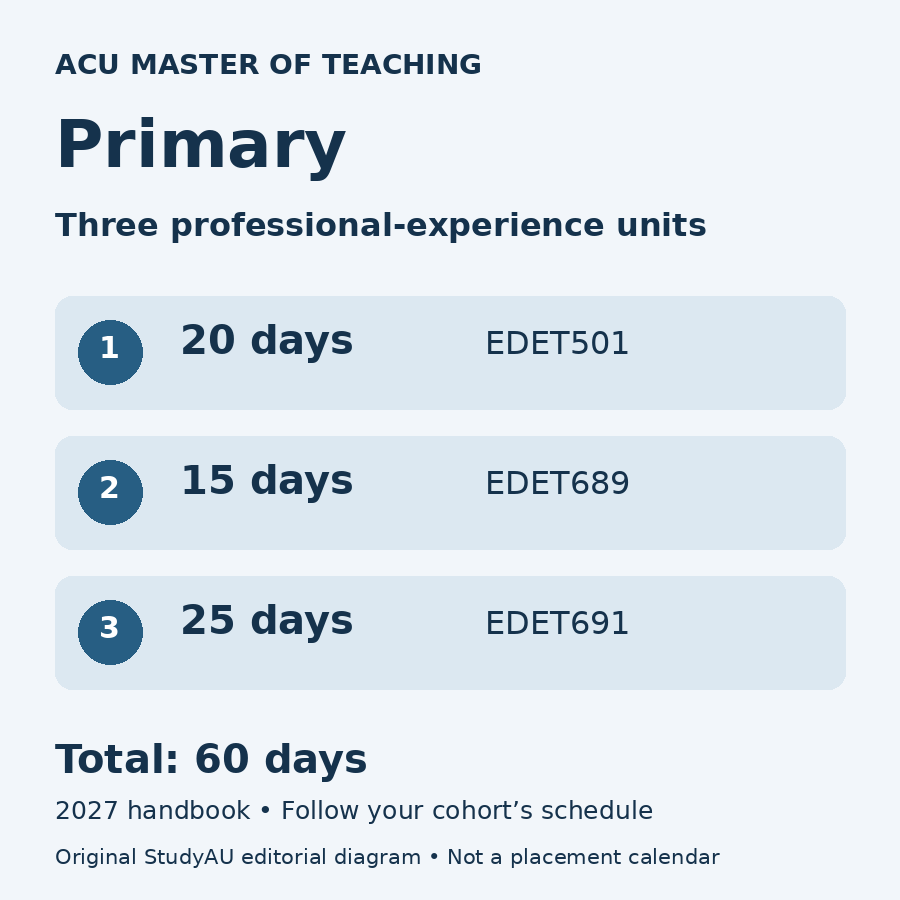
Three placement units total 60 days
The 2027 handbook identifies these professional-experience components:
| Unit | Days |
|---|---|
| EDET501 | 20 |
| EDET689 | 15 |
| EDET691 | 25 |
The final unit specifies a school setting with children aged 8–12 and a teaching-specialisation focus. These requirements total 60 days; the table is not a calendar or school allocation. Handbook unit schedule
ACU says its faculty arranges suitable placements and that the scheduled period can vary. Ask for your cohort’s placement schedule before arranging employment, caring responsibilities or travel. Full-time placement availability deserves a separate check from the degree’s overall duration. Placement arrangements
Check your academic content and professional requirements
For 2027 admission, the handbook requires a completed bachelor’s degree or equivalent, including the equivalent of one full-time year in primary-curriculum learning areas. Victoria has a suitability assessment; NSW has additional mathematics prerequisites. Check the detailed conditions for your location. Handbook admission requirements
For an enquiry, assemble your transcript and relevant subject descriptions, then ask how your previous study is assessed. A broad degree name may conceal the subject content ACU needs to consider.
The workshop places professional experience, LANTITE and child-safety clearances within preparation for school teaching. It also distinguishes course-entry English from teacher-registration English. Keep your admission assessment, course obligations and intended registration process as separate planning stages. The two-year course description cannot establish an individual outcome at all three.
Workshop source: ACU’s official “Beyond the Classroom” presentation, slides 5–6, 9–10 and 13–14. Named course and 2027 handbook sections checked on 17 October 2026.