2026-10-17
ACU Master of Education or Master of Teaching: Which Purpose Fits?
Compare ACU's Master of Education with its three graduate-entry Master of Teaching pathways, including prior-study requirements and registration checks.
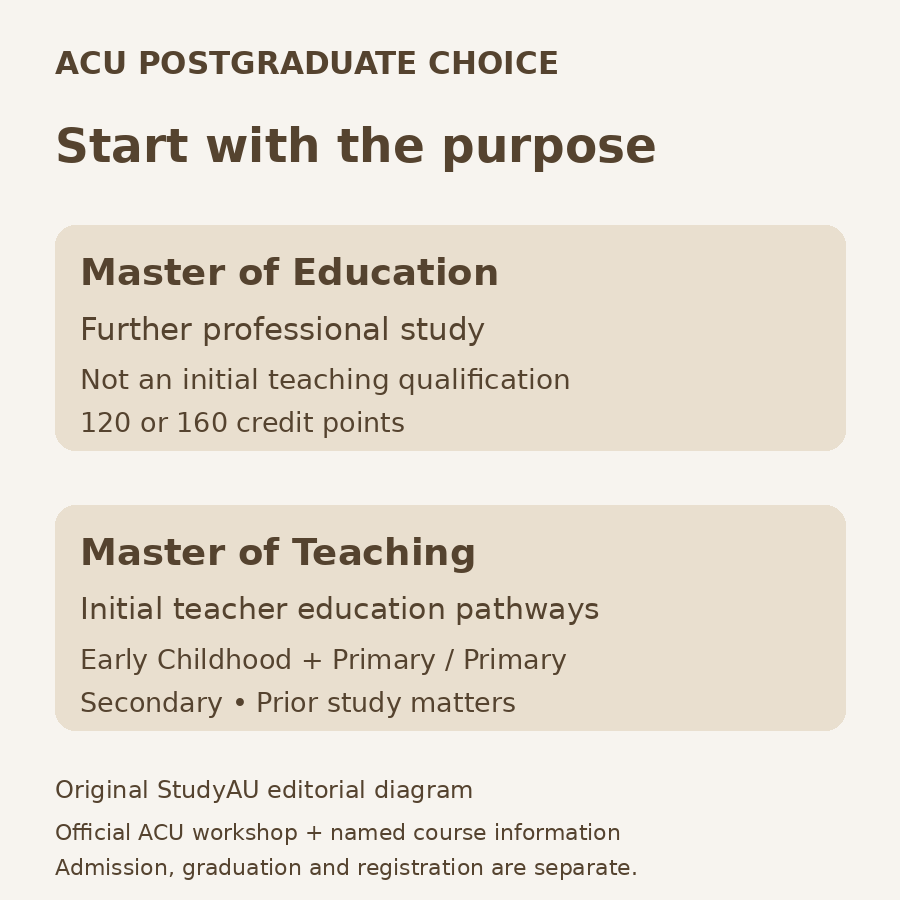
Choosing an education master's degree starts with a practical question: are you seeking your first teaching qualification, or further study for an existing career in education? At Australian Catholic University (ACU), the Master of Education and Master of Teaching serve different purposes. Their similar names can obscure a distinction that matters before you spend time preparing an application.
ACU's official teaching-careers workshop makes the distinction explicit. Slide 9 places the Master of Education under “For education professionals” and identifies it as not being a teaching qualification degree. On the same slide, ACU lists three Master of Teaching courses as two-year graduate-entry pathways.
What is the Master of Education for?
The Master of Education is the option to investigate if you are an education professional considering further study. It is not an initial teacher education qualification and should not be selected on the assumption that it will qualify someone with an unrelated degree to become a classroom teacher.
That distinction describes the course's purpose, rather than providing a complete admissions checklist. Being interested in education does not establish eligibility, and being an experienced teacher does not remove the need to check the course's entry requirements. Review ACU's Master of Education course information against your qualifications and intended professional direction.
ACU’s 2027 course page describes a 120-credit-point version taking 1.5 years full-time and a 160-point version taking two years, or equivalent part-time study. It also explains that professionals without a teaching qualification can complete an additional sequence of units. That provision does not turn the Master of Education into an initial teaching qualification or establish an individual applicant’s eligibility.
The course offers areas of further study such as STEM and wellbeing. Choose an area for the professional learning you want to develop; a specialisation name alone does not establish a new professional registration.
If your main objective is to gain your first teaching qualification, start by examining the relevant Master of Teaching pathway instead.
Which Master of Teaching pathway fits your goal?
The workshop identifies three graduate-entry routes:
- Master of Teaching (Early Childhood and Primary), for applicants considering a pathway spanning early childhood and primary education.
- Master of Teaching (Primary), for applicants focusing on primary teaching.
- Master of Teaching (Secondary), for applicants focusing on secondary teaching and the relevant subject areas.
ACU presents these as two-year pathways in the workshop. Use that as the course comparison point, then confirm the applicable intake, study mode and course requirements before making a study plan. A two-year description does not promise admission or establish that every applicant can complete the course under identical circumstances.
The distinction between the three routes matters more than the shared Master of Teaching title. Select the education sector you want to work in first, then examine the corresponding course. For detailed study and placement checks, see the individual guides to Early Childhood and Primary, Primary and Secondary. The purpose comparison here does not replace the course rules for any of those pathways.
Why your undergraduate subjects matter
Having a bachelor's degree is a starting point for investigating graduate entry, not evidence that every teaching pathway is open to you. The workshop specifically warns that prior degree content matters, particularly for secondary teaching areas.
For a prospective secondary teacher, the useful question is therefore more precise than “Will ACU accept my degree?” Ask whether your completed subjects support the teaching area you intend to pursue. Your degree title alone may not convey the content or depth of your previous study.
Have your academic transcript and relevant subject descriptions available when seeking advice from ACU. Check the 2027 Master of Teaching (Secondary) Handbook for the applicable course rules. Avoid assuming that a preferred school subject can simply be chosen without reference to your undergraduate studies.
Keep admission, graduation and registration separate
Admission determines whether you can enter a course. Graduation depends on completing its requirements. Teacher registration is a separate professional step, so an offer of admission should never be read as a guarantee of registration after study.
English-language requirements also need separate attention: the evidence accepted for university admission should not automatically be assumed to satisfy the relevant state or territory's teacher-registration requirements. Check both for your intended pathway and destination.
For international applicants, confirm campus and intake availability for the specific course and year. A general university campus list is not a list of every location available for your course.
The clearest starting point is your intended outcome. Investigate the Master of Education for further professional study in education; investigate the appropriate Master of Teaching for an initial teaching qualification. Then check your previous study, the exact course requirements and the separate registration requirements before committing.
Sources: ACU’s official teaching-careers workshop, slides 9 and 13; the named Master of Education course page and 2027 Master of Teaching rules, checked on 17 October 2026. The Master of Education page opened in its Domestic setting. Its academic description is used here; domestic fees and offer arrangements are not presented as international applicant information. Confirm the applicable study mode and student-category availability separately.