2026-10-17
ACU Primary and Secondary BEd: Breadth and One Teaching Specialism
See how ACU’s Primary and Secondary degree combines primary curriculum breadth, one specialist secondary teaching area and professional experience in both sectors.
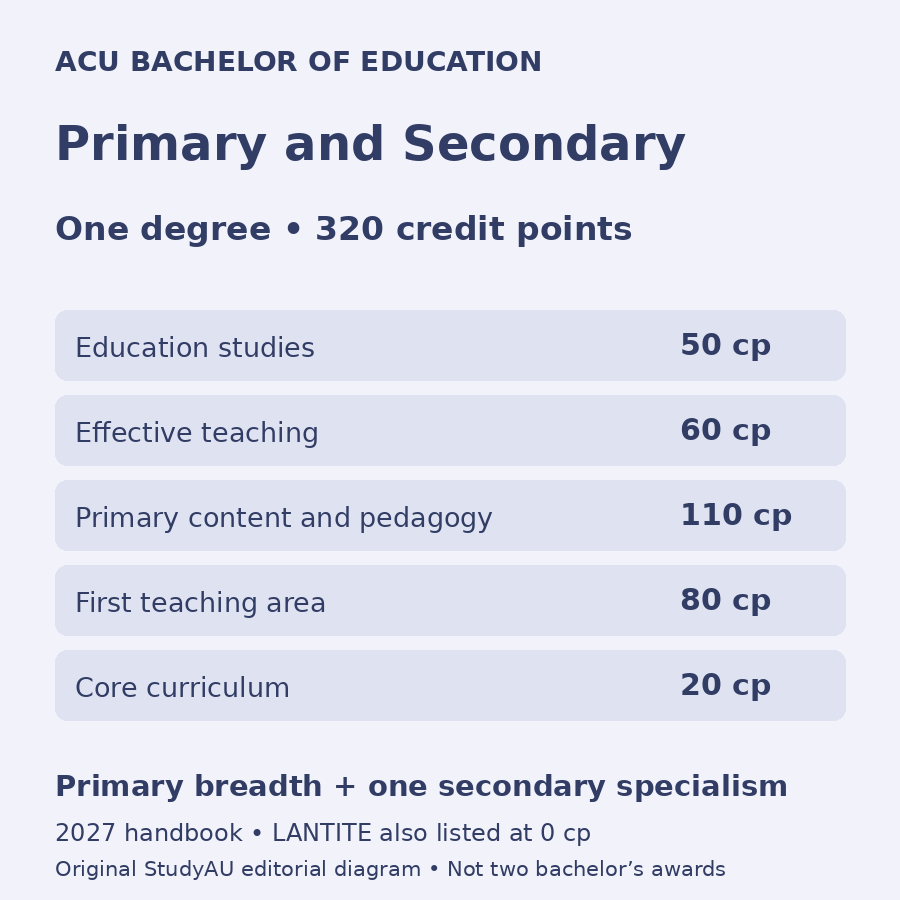
ACU’s Bachelor of Education (Primary and Secondary) brings two teaching sectors into one undergraduate degree. Its structure combines the breadth of primary education with one specialist secondary teaching area. It is a single Bachelor of Education, rather than a double degree awarding two bachelor's qualifications.
The course appears in ACU’s teaching workshop list of 2027 undergraduate pathways. The corresponding 2027 course and handbook information describes a four-year, 320-credit-point qualification with professional experience in both primary and secondary settings. ACU Primary and Secondary course
Two sectors, with different kinds of subject preparation
The important detail is how the two sectors are combined. Primary teaching preparation covers a broad curriculum; the secondary component develops one specialist teaching area. A course covering two sectors therefore does not mean that a graduate has studied every secondary subject as a teaching specialism.
For an applicant, the decision has two parts: whether both primary and secondary settings appeal to you, and which secondary discipline you want to develop. Being uncertain between age groups can make this degree worth investigating, but the subject choice still needs attention.
Compare the permitted teaching areas with the options available for your campus and intake. Interest in a discipline is a starting point for that enquiry, not confirmation that any subject combination can be selected.
Read the credit structure as a whole
The 2027 Handbook sets out these components:
- Education studies: 50 credit points.
- Effective teaching: 60 credit points.
- Primary content and pedagogy: 110 credit points.
- First teaching area: 80 credit points.
- Core studies: 20 credit points.
Together, these make up the 320-credit-point structure. The handbook also lists zero-credit LANTITE requirements. Zero credit does not make a listed requirement optional. ACU 2027 Primary and Secondary Handbook
This breakdown helps explain the course's balance: primary preparation and the secondary teaching area sit alongside education and teaching studies. It is not a semester timetable. Use the applicable course map to establish unit order and prerequisites rather than dividing the totals into your own study sequence.
Professional experience includes both school settings
The course information specifies 80 days of professional experience across primary and secondary placements. That total belongs to this named degree. It should not be replaced with the placement requirements of a different Bachelor of Education or a Master of Teaching.
The course page lists four components: EDET100 has 15 days, EDET201 has 20, EDET301 has 20 and EDET402 has 25. These total 80 days. They do not establish your personal placement dates, school allocation or primary-versus-secondary distribution. Obtain your cohort’s schedule before planning work and travel. Course placement components
Although the total matches the ordinary Primary-only BEd, the qualifications have different sector coverage. The placement number alone cannot establish which teaching scope suits your plans.
Check international availability for the exact intake
The 2027 handbook lists Melbourne and Strathfield among its approved locations and excludes international enrolment at Ballarat, Brisbane, Blacktown and Canberra. Blacktown is not offered for this course in 2027 at all. Those notes define limits; they are not an individual offer for a remaining location. Handbook location notes
A domestic campus or online option elsewhere in the course information should not be treated as an international enrolment entitlement. Check the course, student category, campus and intake together.
Finally, the degree's teaching scope and a person's registration outcome are separate questions. Admission does not establish that all course-completion or professional-registration conditions have been met. The useful reason to consider this pathway is its defined combination of primary breadth and a secondary specialism, not a promise of automatic registration or a wider guaranteed job market.
Sources: ACU’s official teaching workshop, slides 5–7; named course and 2027 handbook sections checked on 17 October 2026. The general course page opened in its Domestic setting; its fees and domestic offer arrangements are not used as international applicant information.