2026-10-17
ACU Bachelor of Education or Master of Teaching: compare your entry route
Compare ACU’s undergraduate and graduate-entry teaching routes by your existing qualifications, intended teaching sector and prior subject study, not duration alone.
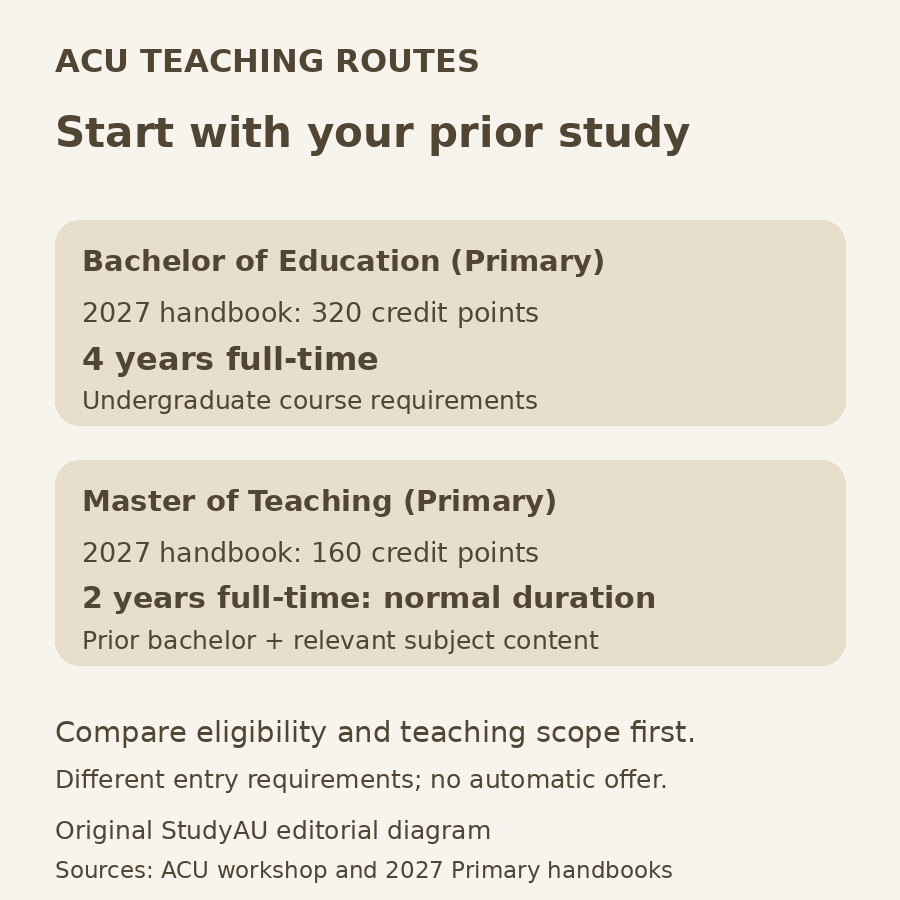
The first question in an ACU Bachelor of Education versus Master of Teaching comparison is what you have already studied. ACU’s official 2026 teaching workshop presents undergraduate teacher education for school leavers or applicants without a degree, and graduate-entry teaching where an existing bachelor’s degree meets the relevant requirements.
A Master of Teaching is therefore not simply a shorter course that any applicant can choose. Your intended teaching sector and the content of previous study help determine whether it is a relevant option.
Use a like-for-like Primary comparison
ACU’s 2027 handbooks make the distinction concrete for primary teaching:
- Bachelor of Education (Primary): 320 credit points and four years full-time, or equivalent part-time. It has undergraduate admission requirements, including relevant school-level prerequisites or equivalents.
- Master of Teaching (Primary): 160 credit points and a normal duration of two years full-time, or equivalent part-time. Entry requires a bachelor’s degree or equivalent with subject content amounting to one full-time year in one or more primary curriculum learning areas. Additional state-specific conditions apply.
The smaller master’s course is built around a different entry point. It does not establish that a student can remove two years from a Bachelor of Education, or transfer between these awards with an automatic amount of credit. Those would be separate course and credit decisions.
Nor does the difference establish that one qualification is automatically better preparation for every applicant. Compare routes for which you could meet entry requirements, leading towards the teaching setting you intend.
If you do not already have a bachelor’s degree
The workshop identifies the undergraduate route as the starting point. Choose the exact award before investigating its entry conditions: primary, secondary and dual-sector courses have different teaching scope.
For example, the Primary handbook’s ordinary Part A course includes education studies, effective teaching, and primary content and pedagogy. It is a planned undergraduate curriculum, rather than a general degree followed by an assumed automatic move into teacher education.
Do not treat every early-childhood course as the same kind of school-teaching award. The separately named Bachelor of Early Childhood Education (Birth to Five Years) has a different qualification boundary. The teaching age-group comparison helps distinguish the settings before you choose an entry route.
If you already have a bachelor’s degree
Start by checking its content against the intended graduate-entry course. For Primary, “one full-time year” concerns relevant subject study; it is not satisfied merely by having spent a year enrolled at university. The actual units and their relationship to primary curriculum learning areas matter.
For Secondary, the 2027 handbook requires an existing bachelor’s degree or equivalent with a major in at least one secondary teaching area that ACU offers. Wanting to teach a subject is not a substitute for the required academic background. An undergraduate degree’s broad title may not show whether that condition is met.
A useful preparation step is to bring together your transcript and relevant subject descriptions, identify the intended teaching sector and subject area, and ask how the completed study fits the course’s requirements. This is practical enquiry preparation, not an official document checklist or a promise of admission.
The workshop names three graduate-entry options: Master of Teaching (Early Childhood and Primary), Master of Teaching (Primary), and Master of Teaching (Secondary). They are separate courses, rather than interchangeable names for one master’s degree. Course availability, campus, intake and applicant category still need individual confirmation.
Compare preparation as well as duration
Both routes in the workshop combine curriculum, pedagogy, assessment, inclusion, professional experience and preparation for registration. Graduate entry should not be interpreted as bypassing the practical preparation involved in learning to teach.
A shorter calendar also does not establish identical placement commitments or a placement schedule compressed in proportion to course length. Compare the actual course requirements. The detailed Primary bachelor’s guide and Primary master’s guide cover their respective structures and professional experience.
If Secondary is your goal, distinguish the undergraduate teaching-area structure from the graduate-entry prior-major requirement. One describes study within the undergraduate award; the other affects entry using earlier university study.
Keep the qualification names and final requirements clear
Master of Teaching is different from Master of Education. The workshop presents Master of Education as further study for education professionals, rather than an initial teaching qualification. The MEd and Master of Teaching comparison explains that purpose distinction.
Admission, successful course completion and professional registration are separate decisions. University-entry English evidence should not automatically be assumed to meet registration conditions. An undergraduate or graduate-entry pathway also does not guarantee employment or a migration outcome.
For a useful final comparison, put your existing qualification and relevant subjects alongside the exact teaching award, its entry requirements and its practical commitments. Duration becomes meaningful after those points fit.
Sources: ACU’s official 2026 teaching workshop, slides 6, 9 and 13–14; the 2027 Bachelor of Education (Primary) handbook, Master of Teaching (Primary) handbook and Master of Teaching (Secondary) handbook. These comparisons concern the named courses; they do not establish an individual international offer, credit decision or accelerated-study arrangement.