2026-10-17
Reading teacher-demand evidence for an ACU course decision
Use ACU’s workshop and dated JSA evidence to check teacher-demand claims by year, classification, location and specialism, alongside your course and professional requirements.
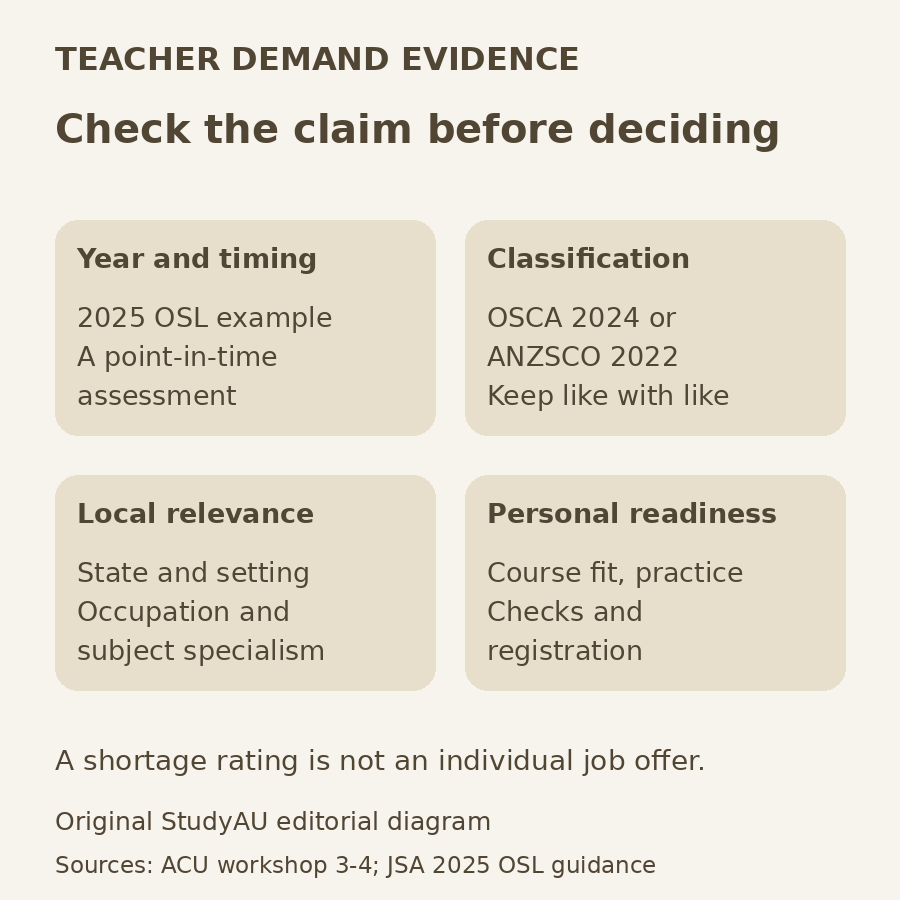
A teacher-shortage headline is one signal for an ACU course decision. It cannot tell an individual applicant which teaching qualification fits their background or where they will find work. ACU’s official teaching workshop qualifies its demand discussion: opportunities vary by state, educational setting, subject and registration eligibility.
A useful comparison therefore connects a defined teaching goal with dated workforce evidence and the course requirements. Jobs and Skills Australia’s guidance helps explain what a shortage statement can and cannot establish.
Understand what a shortage rating means
Jobs and Skills Australia (JSA) describes shortage in terms of employers’ difficulty filling vacancies or specialised skill needs at prevailing pay and employment conditions in reasonably accessible locations.
Its occupation-shortage guidance distinguishes shortage, metropolitan shortage, regional shortage and no shortage. It also warns that a shortage does not necessarily make securing a job easier: particular specialisations or locations can differ, and experience requirements can still create competition. JSA occupation-shortage guidance
For an applicant, the practical implication is to investigate the relevant occupation and place. A broad shortage category is not a vacancy at a particular school or an individual employment offer.
Keep the year and classification attached to the evidence
JSA calls the OSL a point-in-time assessment. The public list page checked on 17 October 2026 presents a 2025 dataset. This dated example should not be relabelled as a new 2026 teacher-shortage ranking. Occupation Shortage List
The October 2025 Key Findings Report also explains that it has two versions of the results: its main analysis uses OSCA 2024, while Appendix A presents ANZSCO 2022 results. These are different occupational classification frameworks. 2025 Key Findings Report
When comparing a claim with another year or source, retain the classification and occupational scope. A broad occupational group, a specific occupation and a school subject specialism should not silently become the same category in the comparison.
This article provides a way to read demand evidence. It does not supply a current teacher vacancy count, occupation-by-occupation 2026 rating, salary forecast or employment probability for ACU graduates.
Apply ACU’s four questions to the claim
The workshop’s qualifications to opportunity make the enquiry more specific:
- State: which jurisdiction or geographic area does the evidence concern? A national statement does not settle a particular local market.
- Setting: does it concern the education sector or type of setting you want to work in?
- Subject: is the claim relevant to the teaching area you intend, rather than teaching in general?
- Registration eligibility: does your intended qualification lead towards the professional conditions you would need to meet?
These are questions for evaluating relevance, not evidence that a particular job is available. They also help prevent a national workforce statement from replacing a course or professional-eligibility check.
For example, an interest in secondary mathematics needs both a relevant secondary teaching pathway and evidence relevant to that specialism and location. A general teacher-demand headline cannot establish that your previous subjects meet a graduate-entry course’s requirements. This is an illustrative course-planning example, not a claim about current mathematics vacancies or an individual’s eligibility.
Assess preparation alongside opportunity
The workshop pairs demand with the qualities behind a sustainable career: purpose, capability, adaptability and belonging. These concern a reason to teach, the craft of supporting learning, continuing to learn, and connections with mentors, colleagues and community.
For course selection, ask what draws you to the work, which capabilities you need to develop and what professional support would help. These are general reflection prompts, rather than an ACU admission test or a promise of a particular mentoring arrangement.
The separate teaching career-development guide explores roles, professional standards and recognition. It addresses a different question from whether a particular workforce statistic is relevant to your intended course decision.
Bring both kinds of evidence into the shortlist
Start with the learners and teaching setting you want, then compare an entry route that fits your prior study. Keep admission, course obligations and professional registration requirements separate.
Use workforce evidence to inform that shortlist, with its date, place and classification intact. Neither the word “shortage” nor strong personal preparation guarantees a preferred position, registration, employer sponsorship or a migration outcome.
Sources: ACU’s official 2026 teaching workshop, “Beyond the Classroom”, slides 3–4; the linked JSA guidance, public OSL page and October 2025 Key Findings Report. The JSA sources were checked on 17 October 2026; the worked evidence is labelled by its dataset year.