2026-10-17
ACU teaching: separate admission, course requirements and registration
Separate ACU teaching-course admission, course completion and professional registration, including English evidence, LANTITE, child-safety checks and early-childhood course boundaries.
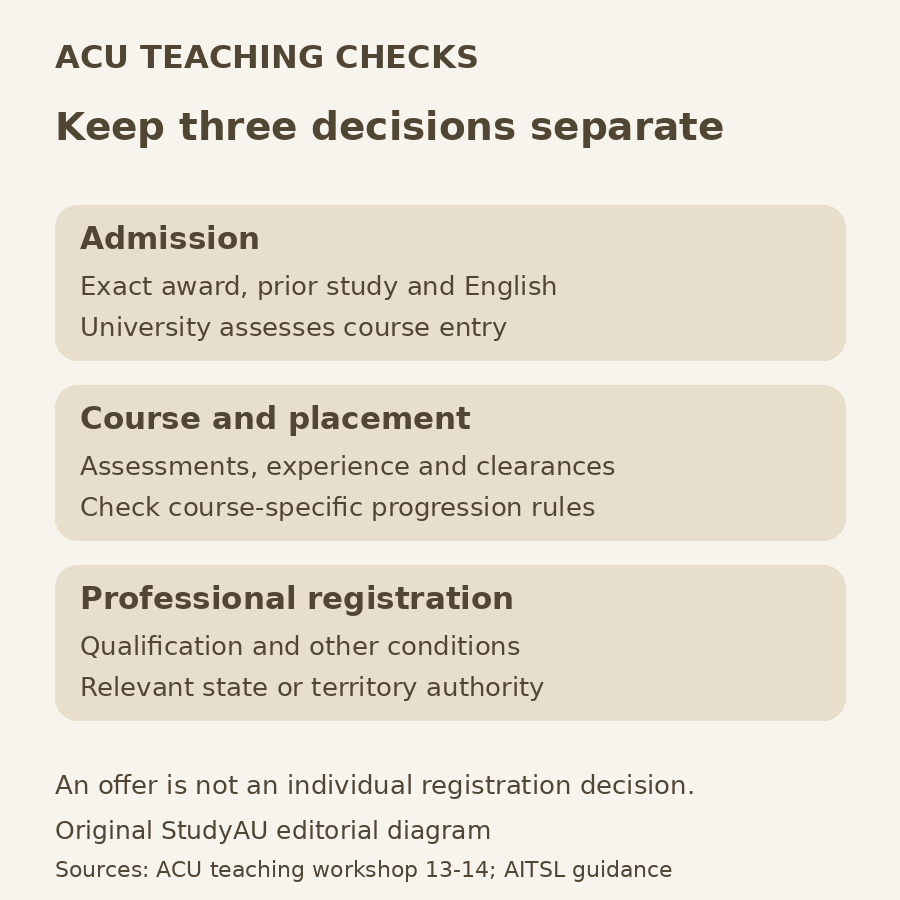
An offer to study a teaching degree answers an admission question. It does not establish that every course, placement or professional-registration condition has been met. ACU’s official teaching workshop asks applicants to distinguish preparation for a degree from preparation for registration, including separate attention to English evidence, professional experience and required checks.
The practical task is to identify what each requirement is for, who assesses it, and when it matters. A named-course example also shows why some requirements affect progression during study, rather than being questions to leave until graduation.
Admission: establish the exact course and applicant context
Start with the full award name, intended intake, campus and student category. For graduate-entry teaching, previous study affects eligibility and, for secondary teaching, the available teaching areas. An existing bachelor’s degree is therefore not an automatic entry entitlement.
Ask how its content relates to the specific course. For international applicants, confirm that the course and intake are available at the chosen campus. These questions belong to admission; a general university campus list or another degree’s graduation requirements cannot answer them.
The Bachelor of Education and Master of Teaching comparison explains the different entry points. That comparison does not make an individual admission decision.
English: identify the decision your evidence supports
ACU’s workshop explicitly warns that English requirements for course entry and teacher registration are not always the same. Evidence accepted for university admission should not simply be assumed to satisfy a registration authority.
Check the exact course’s requirements and those of the relevant registration body. If you have an admission offer, keep its purpose clear: it records the university’s admission decision. It is not a separate determination of registration English eligibility.
No single test score or exemption can safely be inferred from this workshop overview. This article does not provide an individual English-evidence assessment or a complete set of state and territory registration rules.
During study: check progression, not only graduation
For school-teaching preparation, the workshop identifies LANTITE, professional experience and child-safety clearances. The timing and procedures need to come from the applicable course and placement instructions.
For example, the 2027 Bachelor of Education (Primary) handbook requires students to have attempted LANTITE before enrolling in EDET100. Before enrolling in EDET301, they must complete both LNTE100 and LNTE101. These are distinct checkpoints within that named course, not a national timetable for every ACU award. Primary handbook
This is why a course offer should not be treated as evidence that placement checks or later progression conditions are already complete. Find the applicable requirement before making plans that depend on entering a particular professional-experience unit.
The teaching placement learning guide gives a different unit-specific example of attendance and assessment. Neither example replaces your actual course and placement instructions.
Accreditation: check what the program record establishes
AITSL explains that initial teacher education programs are accredited by teacher regulatory authorities in each state or territory. AITSL maintains the national list from information provided by those authorities; it does not itself accredit programs.
AITSL’s explanation also distinguishes the teacher-education qualification requirement from the other conditions for registration. Check the specific program record and consult the relevant authority about the remaining requirements. A course appearing on a program list is not an individual registration decision. AITSL: how program accreditation works
This distinction helps you ask the right organisation the right question: program accreditation concerns the program, while your registration application concerns whether you meet the applicable individual conditions.
Early childhood: keep the qualification boundary clear
The Bachelor of Early Childhood Education (Birth to Five Years) has a different scope from primary or secondary school teaching. ACU’s 2027 handbook explicitly says that its qualification does not permit graduates to teach in those school sectors. Birth-to-Five handbook
Course-specific testing statements also need their scope preserved. ACU’s FAQ says LANTITE is not compulsory for its accelerated Birth-to-Five offering. That statement is not a universal exemption for every course involving early childhood, nor evidence that the accelerated offering is open to a particular international applicant. Accelerated-course FAQ
For a useful final check, keep admission evidence, course and placement obligations, and professional-registration requirements separate. This is a suggested planning approach, rather than an official ACU checklist. A recognised qualification and successful course completion remain different from an automatic guarantee of registration, employment or a migration outcome.
Sources: ACU’s official 2026 teaching workshop, slides 13–14; the linked 2027 course handbooks, ACU accelerated-course FAQ and AITSL program-accreditation explanation. Requirements must be applied to the exact course and intended jurisdiction; no individual eligibility determination is made here.