2026-10-17
Learning through ACU teaching placements: practice, feedback and assessment
ACU’s workshop connects observation, co-teaching and leading learning with feedback. See how a 2027 Primary unit distinguishes placement attendance from assessment.
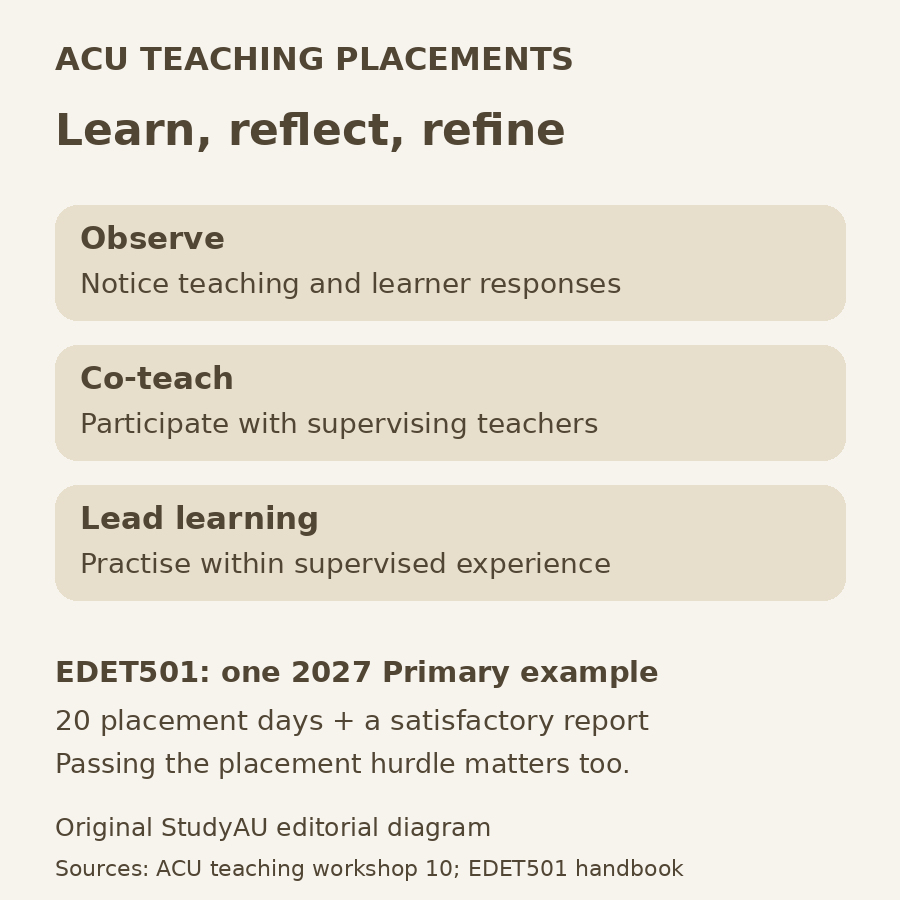
Teaching placements involve learning and assessment as well as time in an education setting. ACU’s official teaching workshop describes supervised professional experience through observing, co-teaching and leading learning, with feedback from qualified supervising teachers.
That gives applicants a useful question beyond “How many placement days?”: how will practice, feedback and evidence of learning connect? A specific 2027 Primary unit provides one example, while the exact requirements still depend on the course and unit you take.
Observe, co-teach and lead within supervision
The workshop’s three forms of participation describe different opportunities to learn from practice. Observation lets a prospective teacher pay attention to teaching decisions and learners’ responses. Co-teaching involves participating with another teacher. Leading learning involves a more active teaching role within the supervised experience ACU describes.
These are not a timetable allocating a set number of days to each activity. The workshop does not say that every student moves through them in an identical order, or that leading a lesson removes supervision. Follow the actual placement’s expectations and agreed responsibilities.
When comparing courses, this distinction helps separate the learning purpose from the allocation schedule. A placement-day total alone does not explain which activities or assessments a student will undertake.
A concrete Primary example: EDET501
ACU’s 2027 EDET501 handbook specifies 10 credit points and 20 professional experience days. Assessment comprises two weighted tasks (40/60 per cent) and two pass/fail hurdles; all four must be passed.
Preparation modules require at least 95 per cent each and the required evidence before placement; this hurdle permits multiple attempts. The placement hurdle requires the 20 days plus a satisfactory Professional Experience Assessment Report, and does not permit multiple attempts within the unit. The handbook directs students to the Professional Experience Handbook and Report for requirements.
Attendance or weighted marks alone are therefore insufficient. This is a named-unit example, not a universal ACU placement rule. EDET501 handbook
Turn supervisor feedback into a teaching decision
The workshop explicitly connects professional experience with feedback from qualified supervising teachers. A useful general approach is to identify one change to try, rather than treating feedback only as a judgement on a completed lesson.
For example, after feedback on an explanation, ask what you would change in the next attempt and how you would check whether learners understood it. That connects an observation about teaching with a decision about what to do next.
This is an illustrative reflection prompt, rather than an ACU marking criterion, prescribed lesson format or account of a real placement. The actual assessment instructions and supervising teacher’s guidance govern the work required.
Keep planning, assessment and inclusion connected
ACU’s workshop groups these elements within evidence-informed practice. A general reflection can consider what you planned, what learners’ responses suggested, and what you would adapt for different learning needs.
The useful connection is between intention and response: planning identifies what you are trying to support, assessment helps you understand learning, and reflection informs the next decision. A personal example or reflection exercise should use only records and information permitted in the placement setting; it is not a reason to collect identifiable pupil information for an independent public portfolio.
These suggestions help interpret the workshop’s learning themes. They do not add new placement tasks, evidence requirements or permission to share school records.
Check the learning requirements and logistics separately
For your exact course and unit, establish both what professional experience is intended to develop and what successful completion requires. Then check the timetable, allocation and practical commitments in the applicable placement information.
The Master of Teaching (Primary) guide explains that course’s professional-experience structure. Other undergraduate and graduate-entry awards have their own requirements; the teaching pathway comparison helps distinguish those starting points.
Do not infer one weekly pattern, school allocation, assessment rubric or feedback deadline from the workshop overview. Its contribution is to show how supervised practice and feedback support learning. The named unit’s requirements establish the more specific assessment example above.
Sources: ACU’s official 2026 teaching workshop, “Beyond the Classroom”, slide 10; and the linked 2027 EDET501 handbook. Reflection examples are general learning suggestions, not additional ACU rules or a guarantee of any particular placement arrangement.