2026-10-17
ACU teaching career directions: roles, professional stages and development
Compare ACU’s teaching career examples with AITSL’s professional stages and voluntary Highly Accomplished or Lead certification. Roles and recognition are different questions.
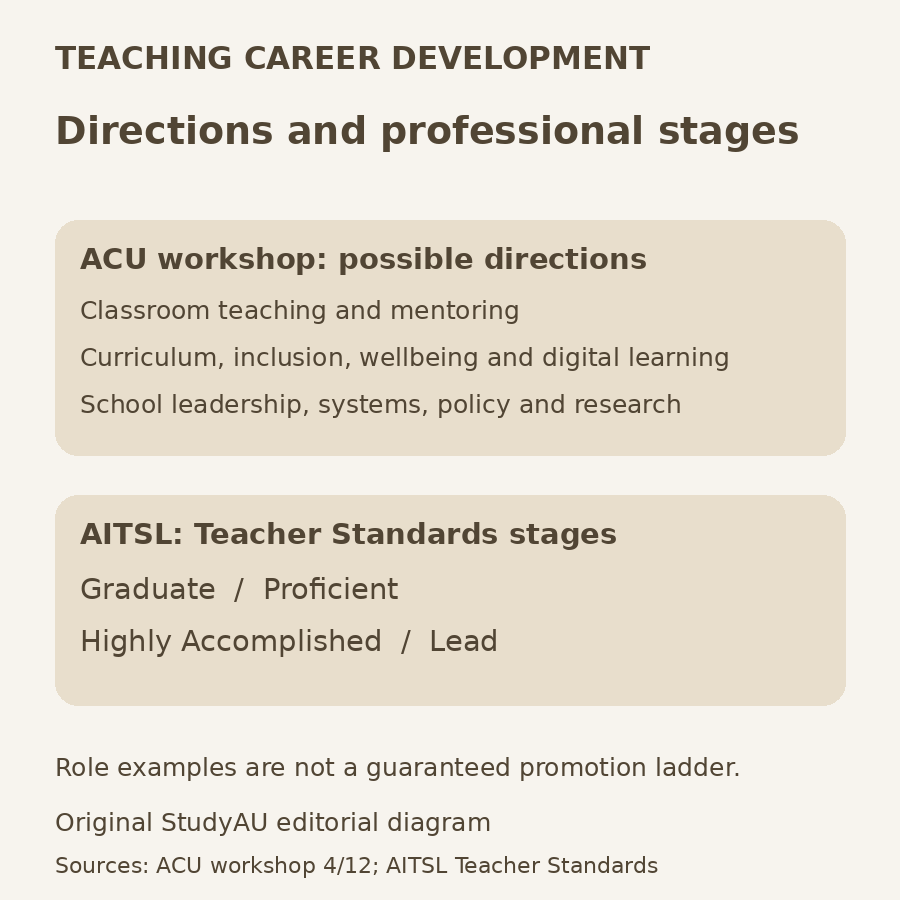
A teaching career can develop through classroom practice, supporting colleagues, specialist work or wider educational leadership. ACU’s official 2026 teaching workshop presents several directions to investigate. It does not prescribe a promotion ladder that every graduate follows.
For a useful career comparison, distinguish three things: the role you might want, the professional practice you are developing, and any separate recognition process. AITSL’s Teacher Standards and certification guidance help explain why those questions should not be treated as interchangeable.
Read ACU’s role examples as possible directions
The workshop names:
- Classroom teacher.
- Mentor or lead teacher.
- Curriculum, inclusion, wellbeing or digital-learning leader.
- Head of department or school leader.
- Roles in systems, policy, professional learning or research.
These describe different contributions. They are not complete job descriptions, selection criteria or successive stages that must be followed in that order. A teaching degree does not guarantee appointment to any of them.
An interest in curriculum work, for example, can help you identify questions to investigate about responsibilities and preparation. It does not establish that a curriculum-leadership vacancy will be available to you or that the workshop sets out a required training route to it.
Professional standards describe practice across career stages
AITSL’s Australian Professional Standards for Teachers describe what teachers should know and be able to do. Their seven standards sit within three domains: Professional Knowledge, Professional Practice and Professional Engagement.
The standards have descriptors at four career stages: Graduate, Proficient, Highly Accomplished and Lead. AITSL explains that you can examine a focus area across stages or look at the expectations for one stage. Teacher Standards
Those are the framework’s professional stages. ACU’s workshop list instead gives examples of roles and areas of contribution. Do not read “mentor or lead teacher” in a workshop career list as evidence that every graduate holds formal Lead certification, or that taking a leadership job automatically meets a standards descriptor. That distinction follows from the different purposes of the two sources.
Certification can recognise expertise while a teacher stays in the classroom
AITSL describes national Highly Accomplished or Lead teacher certification as a voluntary process. Applicants use the relevant career-stage standards to reflect on their practice and its impact on students and colleagues; trained assessors external to the school evaluate practice.
AITSL also makes clear that this development and recognition can happen without leaving classroom teaching. For an experienced teacher interested in certification, the next source is the relevant certifying authority in a participating state or territory, which handles applications and can explain timeframes, costs and support. Become a HALT
This is a professional-recognition pathway, rather than an automatic outcome of completing an ACU degree. This article does not assess an applicant’s certification eligibility, award certification or promise a job, promotion or pay outcome.
Think about the capability behind the role
ACU’s workshop describes sustainable careers through purpose, capability, adaptability and belonging: a reason to teach, the craft of helping learners, continuing to learn, and relationships with mentors, colleagues and community.
For career planning, those themes encourage questions beyond a future title. What contribution interests you? Which capabilities would you need to develop? What professional learning or support would help? These are general reflection prompts, rather than an ACU admissions test or a guarantee of a particular mentoring arrangement.
For example, wanting to support colleagues can lead you to investigate mentoring responsibilities and the practice expected in an actual role. It does not mean that all mentoring roles have identical requirements, or that a certification process and an employer’s appointment process are the same decision.
Connect longer-term interests with the right present decision
If you are choosing an initial teaching course, start with the learners you want to teach and the entry route that fits your previous study. Longer-term aspirations do not remove the course’s requirements or the separate conditions for professional registration.
If you are considering further education study, distinguish its purpose from initial teacher preparation. The Master of Education and Master of Teaching comparison addresses that course-purpose question; it does not establish eligibility for every later role.
Use ACU’s career picture to identify directions worth investigating, and the relevant standards, recognition and employer information to investigate them more precisely. Neither the workshop nor the guidance provides a guaranteed promotion timetable or automatic entry to research study.
Sources: ACU’s official 2026 teaching workshop, “Beyond the Classroom”, slides 4 and 12; and the linked AITSL Teacher Standards and HALT guidance, checked on 17 October 2026. Reflection examples are general planning suggestions, not additional ACU career or certification rules.