2026-10-17
ACU Special Education major: structure and international-student restriction
Understand the 80-credit-point ACU Special Education major, its explicit 2027 international-student restriction and the unresolved EDET202 placement-day difference.
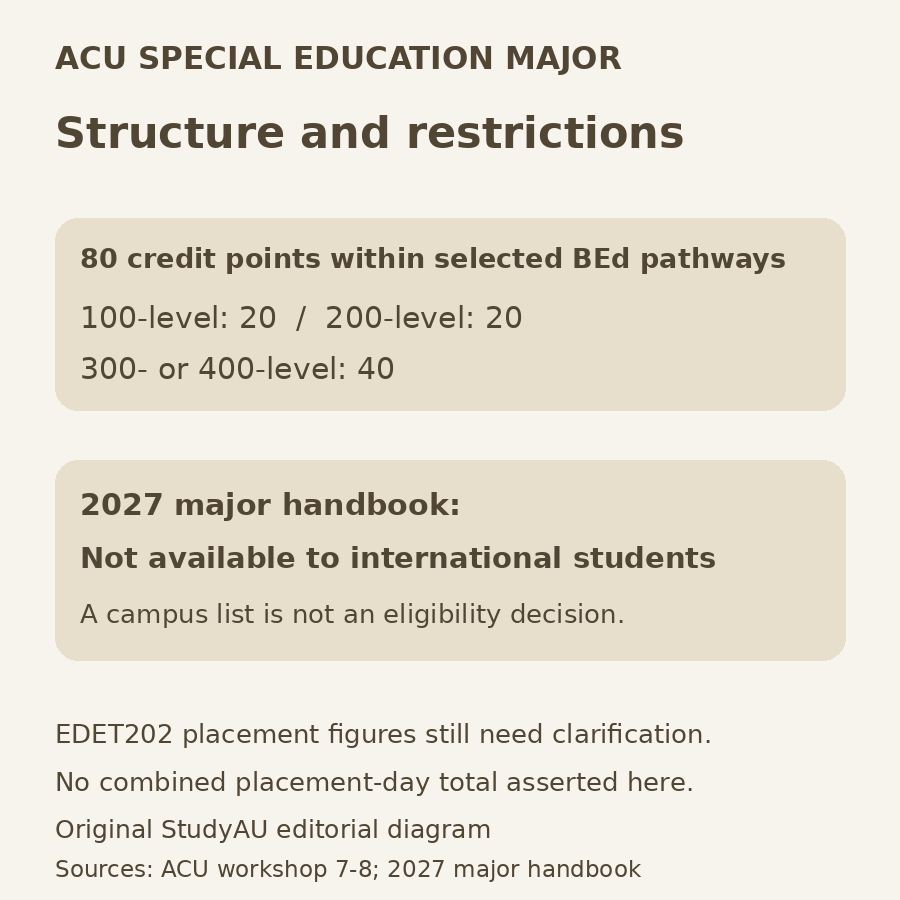
ACU’s official teaching workshop identifies a Special Education major in selected Bachelor of Education pathways. It is a defined study component within a parent degree, rather than a standalone bachelor’s award or an option that can automatically be added to every teaching course.
For international applicants, the first check is decisive: the 2027 major handbook explicitly says the major is not available to international students. The academic structure below explains what the named major contains; it does not establish an international enrolment option. 2027 Special Education handbook
Check the restriction before planning a course map
A university campus list or a broad course overview should not be treated as overriding a major-specific restriction. If you are an international applicant considering this major, obtain ACU’s clarification for the exact parent degree and intended intake before making plans that depend on taking it.
This restriction concerns the named major. It does not mean that all education degrees or every unit dealing with inclusion are unavailable to international students. Conversely, a reference to inclusive teaching in another course’s description does not establish access to this major.
The workshop’s statement that the major exists in selected BEd pathways and the handbook’s international-student restriction answer different questions. The existence of an academic option is not evidence that it is available to every applicant category.
Read the 80-credit-point structure by level
The 2027 major information divides its 80 credit points as follows:
| Unit level | Credit points | Structure |
|---|---|---|
| 100-level | 20 | EDSE100 and EDSE111 |
| 200-level | 20 | EDSE200 and EDET202 |
| 300- or 400-level | 40 | From the listed higher-level unit pool |
The higher-level pool lists six 10-credit-point units: EDET300, EDSE300, EDSE401, EDSE301, EDEN345 and EDMA345. A requirement to complete 40 credit points from that pool is not a requirement to complete all six. Use the approved parent-course map to establish the applicable selection and sequence. 2027 major course information
The distinction matters when comparing study plans. The major is a structured 80-credit-point component; its presence does not establish that every listed unit is an extra subject added on top of the degree’s total requirements.
Establish how it fits the parent degree
The relevant 2027 Bachelor of Education (Primary) and Bachelor of Education (Secondary) handbooks each describe a 320-credit-point, four-year degree with a major-related structure. That identifies academic arrangements, rather than resolving an individual’s eligibility.
For Secondary, distinguish the ordinary first-and-second-teaching-area structure from the alternative combining a first teaching area with Special Education. The major should not be assumed to sit automatically on top of two existing teaching areas.
The Primary course guide and Secondary course guide discuss their respective structures and restrictions. An interest in inclusion does not establish that the major can instead be added to Early Childhood and Primary, Primary and Secondary, or a secondary double degree.
Keep the EDET202 placement difference unresolved
Both 2027 major pages give 30 professional-experience days for EDET202. The Primary course overview gives a different additional-placement figure of 20 days. This difference needs course-specific clarification; it should not be hidden by choosing the larger or smaller figure.
This article therefore gives no combined placement-day total for a BEd with the major. Do not add the ordinary course’s placement total to an assumed additional figure and treat the result as a confirmed commitment. Primary course overview
A focused enquiry can name the parent degree, Special Education major, intended intake and EDET202, then ask for the applicable course map and professional-experience requirements. This is suggested enquiry preparation, not an official application checklist or a resolution of the discrepancy.
Separate inclusion content from a particular major
ACU’s workshop describes inclusion within teacher preparation more broadly. A course can contain inclusion-related learning without offering the named Special Education major to a particular student.
For a useful comparison, establish the exact award and major, the applicable student-category rules, and the approved study plan. Those checks are separate from an interest in working in inclusive or specialist education settings. Neither the major’s description nor this academic overview guarantees personal registration, a teaching appointment or a migration outcome.
Sources: ACU’s official 2026 teaching workshop, slides 6–8; the linked 2027 major pages and Primary course overview; and the 2027 Primary handbook and Secondary handbook. The international-student restriction remains in force in this comparison, and the placement-day difference remains unresolved.