2026-10-17
ILSC University Pathway: why partner conditions differ
Compare partner-specific English course formats in ILSC’s Australian pathway brochure and keep language completion separate from the admission decision.
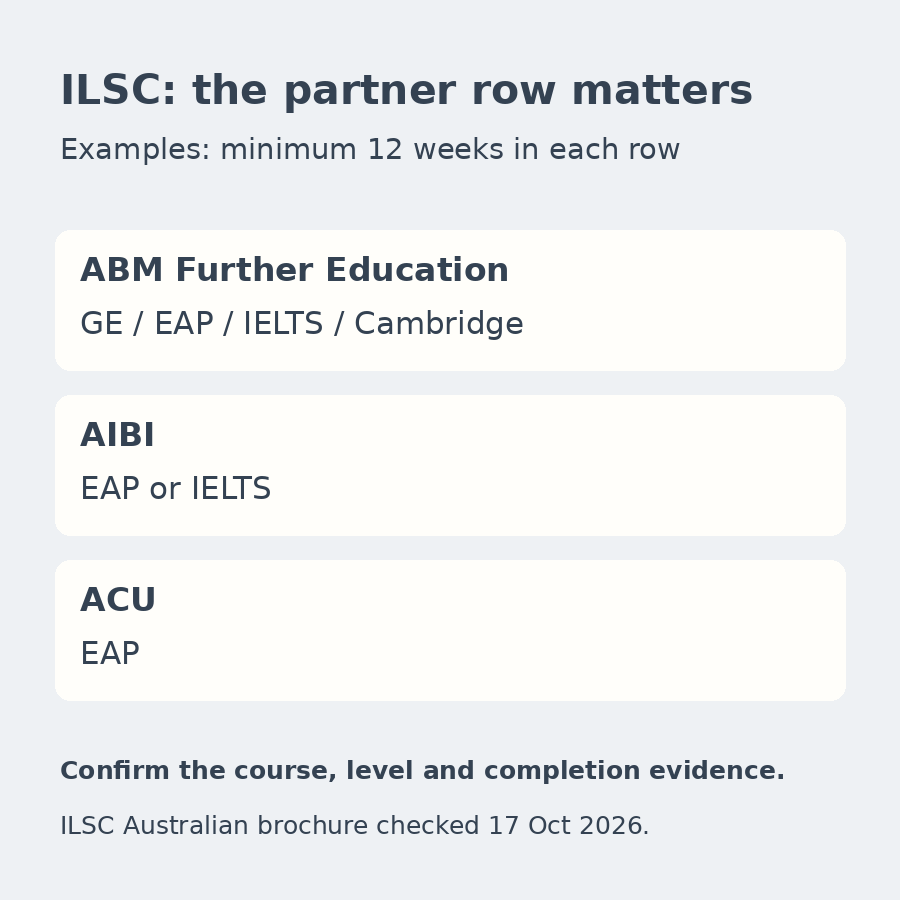
ILSC’s University Pathway can address the English-language condition for participating courses, but the accepted English study is not identical across the partner network. The Australian partner brochure gives a concrete reason to check the receiving institution: two partners may specify the same minimum number of weeks while accepting different course formats.
The official 2026 workshop introduces a network of more than 155 universities, TAFEs and other partner institutions across Australia, Canada and the United States. That describes the network presented in the workshop. It is not a course-by-course acceptance list or a promise that every degree at a named institution has the same arrangement.
Compare the accepted English course, not only the weeks
In the official Australian partner brochure checked on 17 October 2026:
- ABM Further Education’s row specifies at least 12 weeks of University Pathway study and lists General English, English for Academic Purposes (EAP), IELTS and Cambridge formats.
- Australian Institute of Business Intelligence’s row also specifies at least 12 weeks, but lists English for Academic Purposes or IELTS.
- ACU’s row specifies at least 12 weeks of English for Academic Purposes. The ACU pathway guide explains that institution’s published level range and the brochure’s level-heading convention.
These are examples from the provider’s partner table, rather than enrolment decisions for individual applicants. The point is the difference in accepted formats: “12 weeks of English” is an incomplete description of the proposed route. A General English option named in one partner’s row should not automatically be transferred to another partner whose row specifies EAP. ILSC Australian pathway partner brochure, PDF page 2
The table also identifies destination courses or subject areas and has level headings. Read the relevant row as a whole. A partnership with a college, TAFE or university does not make all of its qualifications interchangeable, and a short institution-level description does not replace the requirements of your chosen programme.
Keep the language condition and the offer separate
The workshop describes pathway completion as a way to meet English-entry requirements for many partner courses without a separate IELTS or TOEFL result. That is a language arrangement. It does not show that an applicant’s previous qualifications have been assessed, that other admission conditions have been met or that a place has been offered.
For a useful check, put the institution, exact course, campus and intake beside the proposed ILSC programme. Identify the required study format, minimum weeks, level or result, and completion evidence. Then keep any remaining academic or other offer conditions on the same record.
These are planning questions, not additional admission rules. They help you avoid treating a partner logo or the phrase “without IELTS” as an unconditional admission decision. The pathway still has to be completed successfully under the receiving institution’s arrangement.
Use the general duration wording in its proper scope
The workshop’s University Pathway overview uses a general minimum range of four to 12 weeks. It does not map each number to every destination, starting level or applicant. Selecting the shortest number from the overview therefore cannot establish a personal completion date.
The Australian brochure says students must complete both the partner’s required weeks and the final level for the chosen programme. Its programme page also explains that the schedule and required courses depend on the destination requirement. Time booked and an appropriate completion result are separate parts of the plan. ILSC brochure, PDF page 1
Use the assessed starting point and the confirmed destination conditions to build a provisional timeline. The ILSC levels and duration guide explains the workshop’s full-time chart; it does not turn a minimum period into guaranteed progress.
Use advising to confirm the actual route
The workshop describes academic and advisory support. A practical use of that support is to resolve the details before organising the rest of the application: which partner course accepts the route, which English classes must be taken, what result is required and how completion evidence reaches the receiving institution.
The useful outcome is a clear connection between a particular English programme and a particular destination. Keep that confirmed arrangement with any remaining offer conditions, rather than relying on the size of the overall partner network.
Sources: ILSC’s official “6.ILSC AUS 2026 -ACU.pptx”, slide 7, and the official Australian partner brochure checked on 17 October 2026. PDF page 1 corresponds to printed pages 14–15; PDF page 2 corresponds to printed pages 16–17. The named partner rows illustrate differences in the published arrangements, not current place availability or an individual admission outcome.