2026-10-17
ILSC levels and study duration
Read ILSC level codes and full-time pathway duration examples without confusing minimum study periods, personal progress or external test results.
How long an ILSC English course may take depends on the starting level, the achievement level being sought and the study arrangement. The official 2026 Australia workshop provides both a level guide and a University Pathway Australia duration chart. They answer different questions and should be read together.
The duration chart is labelled “FT ONLY”, meaning full-time only. It lists minimum study periods, not guaranteed completion dates for every learner. It should not be applied unchanged to part-time study or to an online option with a different weekly workload.
Read the ILSC codes as their own sequence
Slide 9 groups ten ILSC levels into five broad bands:
- Elementary: B1 and B2.
- Pre-Intermediate: B3 and B4.
- Intermediate: I1 and I2.
- Upper-Intermediate: I3 and I4.
- Advanced: A1 and A2.
The comparison table on slide 10 expands the B codes as Beginner and the I codes as Intermediate. These are ILSC labels. In particular, ILSC A1 is an advanced level in this sequence; the same letters in another language framework do not necessarily mean the same thing.
The table also identifies an ILSC Academic English Placement Test scale. For planning, establish the assessed starting point rather than choosing a level from a self-description such as “quite fluent”. The slides do not supply the full assessment procedure, so they should not be used to invent a test format or predict a personal placement result.
Use the entry and achievement columns together
The duration table has three elements: entry level, achievement level and total minimum study period in weeks. Read across the relevant row rather than looking for one universal course length.
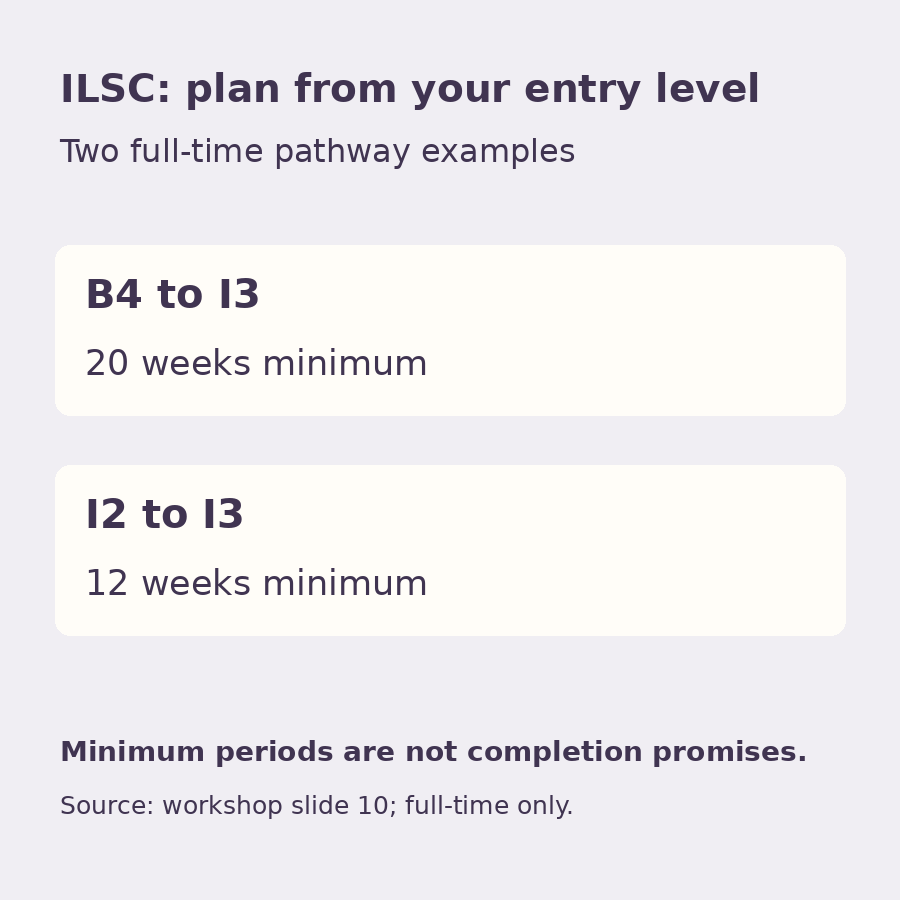
For example, the published chart shows a 20-week minimum from B4 to I3, and a 12-week minimum from I2 to I3. These are two rows from the chart, not promises about particular students. They illustrate why knowing the target level alone is insufficient: the starting point changes the planning figure.
The heading also states that progression through a level generally requires four to eight weeks, subject to individual learning needs, progress and attendance. Some students may progress faster; others may need to extend their studies to reach the target and meet programme-entry requirements.
Keep that progression guidance separate from the table's total minimum periods. Multiplying the number of levels by four weeks does not reproduce every minimum shown in the chart. Use the published row and the requirements of the intended programme rather than constructing a shorter route yourself.
A comparison table does not issue a test result
Slide 10 places ILSC levels alongside several language frameworks and examinations. Those comparisons help explain the provider's level structure; completing an ILSC level does not mean you have sat the corresponding external examination or received its score report.
Do not turn a comparison row into a claim that a visa authority, professional regulator or every university will accept that level as a substitute for a named test. Acceptance depends on the specific purpose and receiving body's requirements. This article does not provide a visa or registration score-conversion guide.
The table's footnote also describes A2+ as a designation for students who successfully complete A2 with an overall grade of A or B. It is not presented as an extra numbered course level beyond A2. Where a destination specifies a particular completion level or result, retain that exact condition rather than shortening it to “advanced English”.
Build a provisional plan, then check its assumptions
A useful study plan records the assessed entry level, the required achievement level, the applicable study format and the minimum period shown for that combination. Keep the expected completion date provisional until the relevant course requirements and individual study plan are established.
If the goal is a later university intake, allow for the possibility that progress takes longer than the minimum. The workshop does not provide a universal buffer, so there is no basis for promising that a fixed number of extra weeks will always be enough.
Source: ILSC's official “6.ILSC AUS 2026 -ACU.pptx”, slides 9–10, including the image-based level comparison, its A2+ footnote and the full-time University Pathway Australia study-duration chart. Planning suggestions are general guidance, not a personalised duration assessment.