2026-10-17
Choosing ILSC adult English courses
Choose ILSC General English using foundation, communication and creative class examples, level ranges, and the workshop’s 16+ scope.
ILSC’s General English offering includes foundations, communication, creative subjects, business English, and academic or exam preparation. The first choice is therefore a class that fits your present level and learning goal. “General” does not mean that every student studies only basic conversation.
The official 2026 Australia workshop describes the adult offering as “16+”. That is the age scope in the presentation, rather than a complete enrolment checklist. It does not explain the arrangements for students under 18.
Start with foundations or communication
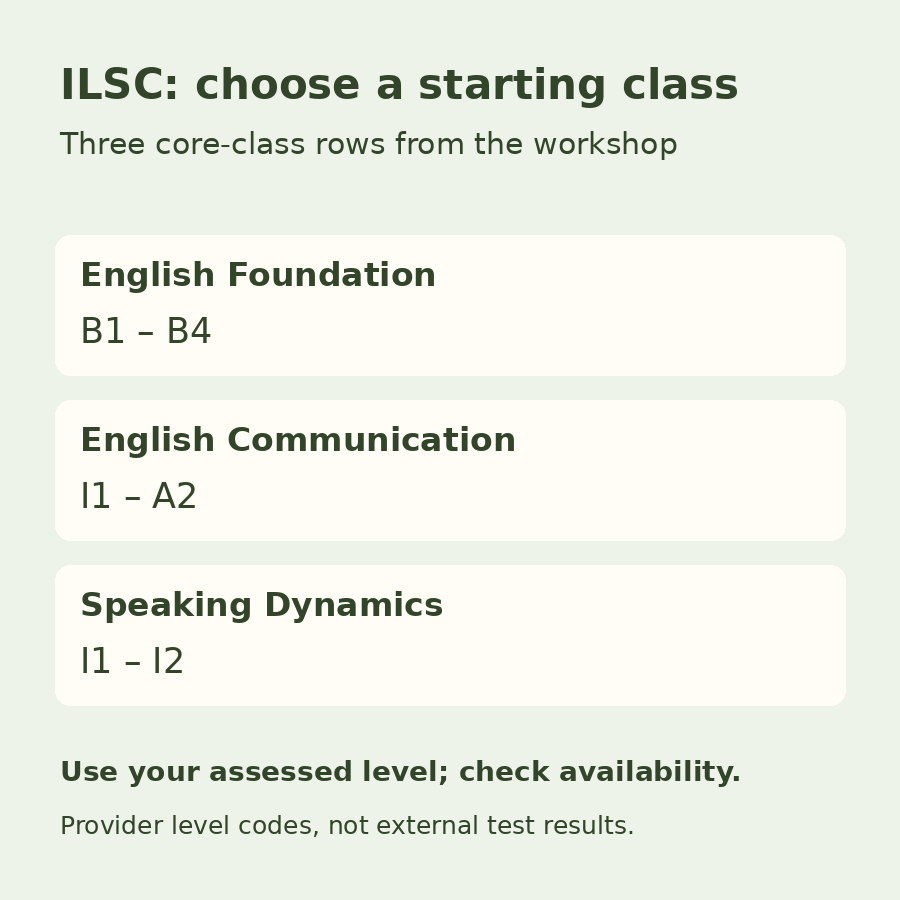
The workshop’s course-selection chart separates English Foundation from communication classes. It lists these core-class ranges:
- English Foundation: B1–B4.
- English Communication: I1–A2.
- Speaking Dynamics: I1–I2.
Those are ILSC’s own level codes. They should be read using the ILSC level guide, rather than treated as identical to similarly named levels in another framework.
The rows show why a topic preference is only part of the decision. English Communication spans a different range from English Foundation, while Speaking Dynamics has a narrower intermediate range. An assessed starting level helps you identify which classes to ask about; the chart does not let a reader choose a placement result for themselves.
The chart also has campus columns. A listed level range does not establish that a class runs at every Australian location or on your intended start date. Confirm both before treating a row as an available place.
Use creative interests to choose a class
The Australia overview names art, drama, music and yoga as ways to study English through creative or cultural interests. These are language-learning choices: enjoying an activity can help you identify a topic you want to discuss, read about or write about in English.
The more detailed chart separates core classes from electives. For example, English through the City appears among core classes at B4–A2, while English through Art appears among electives at I1–A2. That distinction matters when asking how a creative option would fit into the rest of your course.
Neither name establishes an itinerary, an art qualification or the exact balance of activities in a particular class. Ask for the actual class description and availability. The workshop does not promise that every creative subject is offered immediately to every student.
Keep a focused later goal in view
Business English and academic or exam preparation also appear within the General English overview. Medical English and named exam-focused options appear under Specialized English. The specialised English comparison explains the relevant class ranges and core/elective differences.
For this initial choice, identify the immediate skill you want to develop. Following a discussion, explaining an idea in writing or preparing for a named examination are different goals. These examples are planning prompts, rather than results guaranteed by enrolment.
If university entry is a later objective, keep the destination’s accepted English conditions alongside your class choice. An interesting academic class does not by itself establish an approved university pathway.
Confirm a workable first selection
Before committing, establish the campus, start date, assessed level and available core or elective class. Clarify how class selection and later changes work for that enrolment: the workshop describes flexibility but does not set out unrestricted switching rights.
A useful shortlist has a reason for each choice. Record the skill you want to practise, the class that addresses it, the level range and whether it is actually running. That gives a more concrete starting point than choosing the longest catalogue or the most specialised-sounding title.
Source: ILSC’s official “6.ILSC AUS 2026 -ACU.pptx”, slides 5–6. The adult age label and course families come from slide 5; the named core/elective examples and ranges come from the two class-selection tables on slide 6. The chart covers multiple campuses, so its rows are not a live Australian availability guarantee. Planning suggestions do not create additional enrolment rules.