2026-10-17
Australian Catholic University (ACU): Social work entry and prior-study evidence
Understand ACU social work prior-study evidence: qualification equivalence, relevant subject content and the amount of social and behavioural science study.
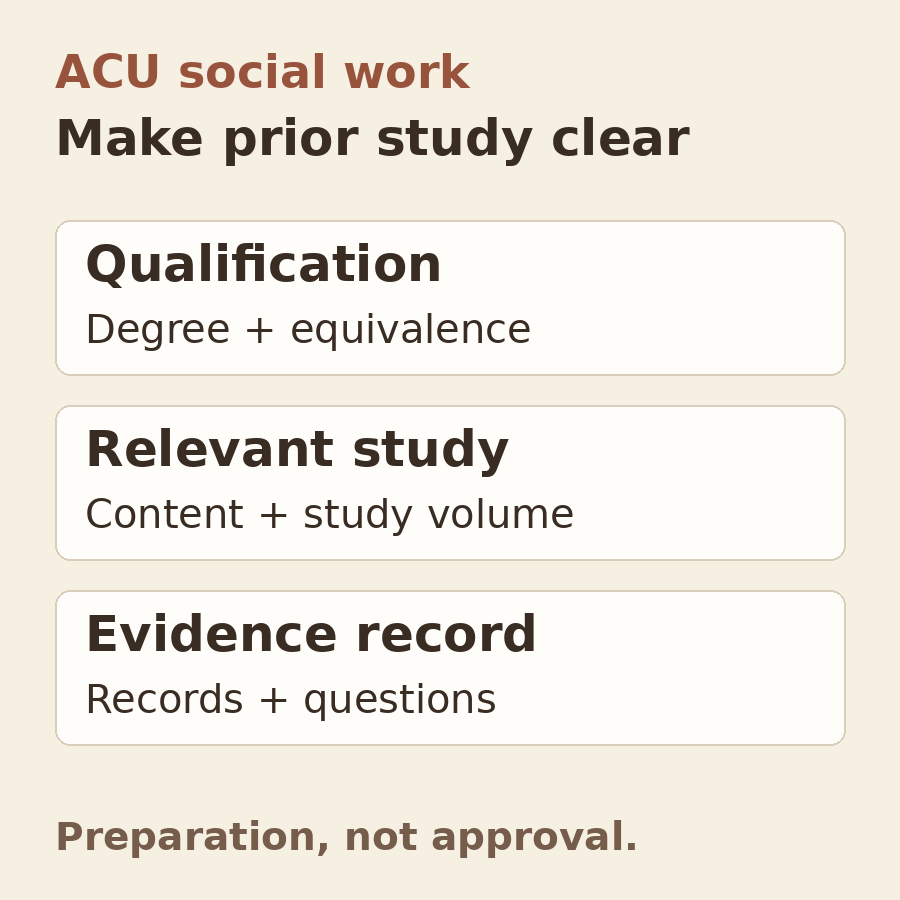
A degree certificate shows what qualification you completed. For Australian Catholic University's Master of Social Work (Qualifying), applicants also need to consider what they studied within that qualification. A promising degree title alone does not establish that the prior-study requirement has been met.
ACU's official Shantou social work workshop describes a relevant three-year Australian bachelor's degree, or equivalent, containing at least one year of full-time study, or its equivalent, in the social and behavioural sciences. This creates two connected questions: whether the qualification is relevant and equivalent, and whether it contains enough relevant study.
The practical task is to make your academic record understandable. The approach below is a preparation method, not an ACU application form or an official list of required documents.
Separate the qualification from its subject content
Start with the exact qualification name, awarding institution, completion status and normal study load. Keep those details distinct from the subjects you believe may be relevant. This prevents a common shortcut: treating the overall length of a degree as proof of the amount of social and behavioural science within it.
A qualification lasting three years does not necessarily contain one full-time-equivalent year in the required area. Conversely, the relevant study may be spread across several academic years rather than appearing in a single named year of the degree. The workshop states an amount of study; it does not provide a formula for converting every international credit system.
Use your institution's documented credit or workload information rather than inventing an Australian equivalence yourself. If the transcript uses a different credit scale, retain the explanation of that scale alongside it.
Build a subject-level evidence record
A simple working record can help connect a transcript entry to what was actually taught. For each potentially relevant subject, note:
- Its title and code, matching the transcript.
- The credit value and the institution's explanation of a normal full-time load.
- The period in which you completed it.
- The published description or learning outcomes for that version of the subject.
- The reason you think its content relates to social or behavioural science.
These are suggested organising fields, not mandatory ACU submission headings. Use existing academic records; do not rewrite course descriptions to make them sound more suitable.
Where a subject title is broad, its description may explain the content more clearly. Where a subject combines several fields, flag that uncertainty instead of automatically counting its entire credit value. ACU's assessment, rather than an applicant's spreadsheet, determines how the prior study is treated.
Keep clear evidence separate from unresolved questions
During your own preparation, distinguish subjects whose relevance you can explain from those that need clarification. This is a way to organise questions, not a self-issued eligibility result.
For example, do you have the description used when you took the subject, or only a newer version with different content? Does a transcript show transferred credit without explaining the original subject? Are the units on different records measured on the same scale? Identifying such gaps makes the record easier to follow and avoids presenting an uncertain total as settled.
Count a completed subject once in your working record. If it appears in both an original transcript and a credit-transfer record, make that relationship visible. The workshop does not establish a rule for every transfer-credit or mixed-content case, so those cases should remain questions rather than assumed approvals.
Treat the result as preparation for assessment
Your aim is a concise explanation supported by records: what qualification you completed, which study may be relevant, how its workload is documented and what still needs a decision. A long personal statement cannot replace evidence of the academic content or study volume.
The ACU international course information identifies the qualifying master's to which this discussion relates. Keep the exact course and intended intake attached to your enquiries; a prior-study review is only one part of an admission decision.
For practical commitments after entry, see the ACU social work placement and attendance planning guide.
Neither a familiar degree name nor a self-calculated credit total guarantees an offer. A well-organised record is useful because it exposes what is supported and what remains uncertain before you make study plans that depend on acceptance.
Source note: The course context and prior-study threshold come from ACU's official “4.1.Social work PPT for ACU Shantou workshop 2026_SMedits.pptx”, slides 5 and 7. The evidence-organising suggestions are general applicant guidance, not additional university requirements.