2026-10-17
ACU Data Science: Master’s Curriculum Themes and 2027 Units
Read ACU’s data science workshop themes alongside the eight specified units in the 2027 combined degree’s master’s component, with project and offering limits.
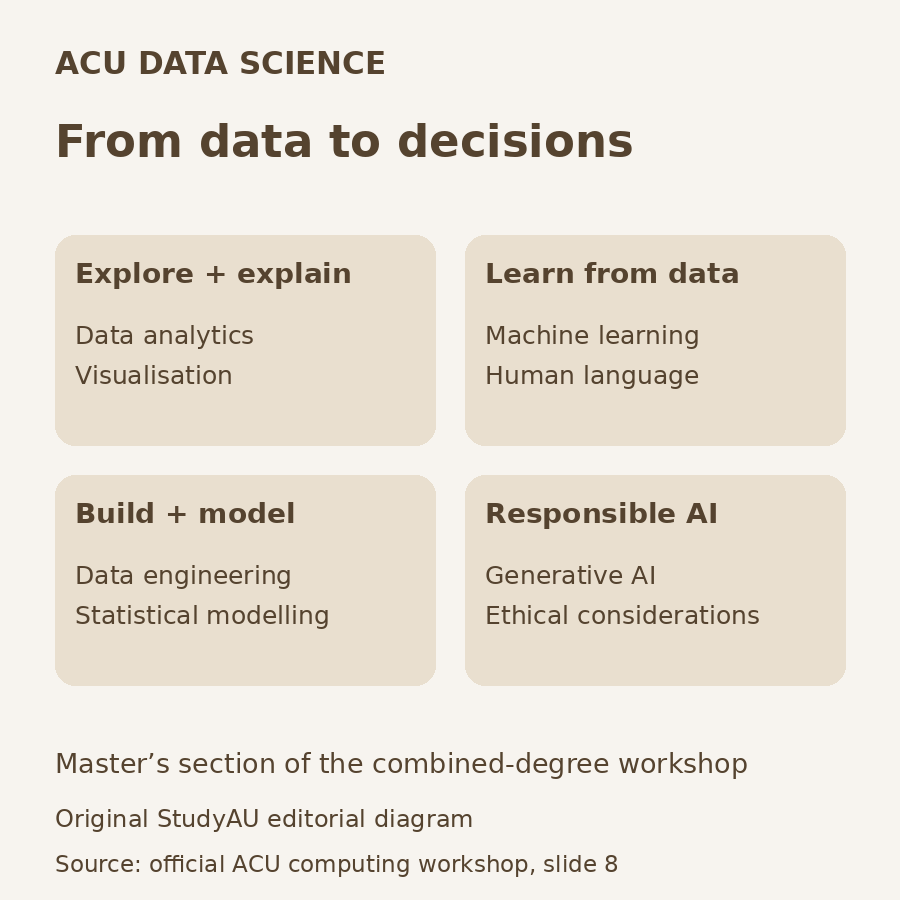
The Data Science curriculum described in ACU’s 2026 computing workshop belongs to its Master of Data Science section. It brings together data analytics and visualisation, machine learning, data engineering and statistical modelling, and generative AI with responsible automation.
The presentation introduces the Bachelor of Computer Science and Master of Data Science together. The 2027 unit examples here refer specifically to the 80-credit-point master’s component of that combined degree, rather than establishing the structure or entry requirements of every separately offered data science course.
These areas offer a more useful picture than treating data science as another name for AI. The outline includes preparing and analysing data, communicating insights and considering how automated solutions are used. It is a set of curriculum themes, not a list of four units or four semesters.
Analysis includes communicating what the data shows
Under data analytics and visualisation, slide 8 describes turning complex data into visual stories that support insights. Communication is therefore part of the content presented, alongside analysis.
For an applicant comparing courses, this is a reason to look at how the relevant units connect analytical work with explaining results. The workshop does not name a required visualisation package or specify a particular report or dashboard assessment.
Machine learning is one part of the curriculum
The machine-learning area is described in terms of building systems that learn from data and understand human language. It is presented alongside the other areas, rather than as the entire degree.
The slide does not provide a list of models, programming libraries or prerequisites for individual units. Applicants with a particular technical interest need that additional detail before assuming the course centres on one method or application.
Data engineering and statistical modelling sit together
This area concerns building robust data pipelines and applying statistical techniques to real problems. Its presence helps distinguish the curriculum from a course outline focused only on producing visual outputs or using an AI interface.
The workshop’s themes are not separate credit blocks. The 2027 handbook instead lists eight specified master’s units, each worth 10 credit points:
| Curriculum focus in the unit names | Units |
|---|---|
| Data preparation, machine learning and related AI/data-mining topics | DTSC610, ITEC623, ITEC632 |
| Statistical modelling and predictive analysis | DTSC620, DTSC630 |
| Data analysis and visual communication | ITEC622 |
| The two data science project stages | DTSC641, DTSC642 |
This table groups unit names for reading convenience; it does not create official streams or assign a separate engineering-versus-statistics credit split. Follow the named course’s enrolment guide and adviser’s directions for the actual sequence.
Responsible automation accompanies generative AI
The generative AI and responsible automation area places ethical considerations at the forefront of developing AI solutions. This is part of the stated curriculum framing, not a claim that every project will use generative AI or that the degree awards a separate professional AI certification.
The same slide says final-year work tackles real-world challenges across business, healthcare, government and other fields. Those sectors describe the kinds of challenges presented in the workshop. They do not identify a guaranteed employer, internship, client assignment or placement for an individual student.
The 2027 DTSC641 page describes the first project stage as literature-based investigation, preliminary analysis and planning for a subsequent project stage. That supports a more concrete question about how a proposed problem will be developed. It does not establish a guaranteed company client. The page currently lists no unit offerings, so its curriculum description is not confirmation of a particular semester or class booking. DTSC641 unit information
What needs a closer look before applying?
Use the four areas to identify the detail that matters most to your interests: analytical communication, machine learning, data infrastructure, statistics or responsible AI development. Then check the applicable unit descriptions, learning outcomes and project arrangements.
These are suggested comparison questions, not additional admission conditions. The workshop overview alone cannot determine credit for previous study, progression from the bachelor's component or eligibility for a particular project. Nor can curriculum content guarantee a graduate role.
Sources: ACU’s official computing workshop, slide 8, “Master of Data Science: Turn data into decisions”; the specified master’s-unit section of the 2027 combined-degree handbook and the named DTSC641 entry, checked on 17 October 2026. For the distinct progression and award-exit questions, see the combined-degree structure guide.