2026-10-17
ACU Computing Projects: From Ethical Ideas to Assessed Evidence
Connect ACU’s workshop project themes with the 2027 DTSC641 and DTSC642 assessment sequence, including evidence, evaluation, authorship and offering limits.
ACU’s computing workshop connects practical work with ethical judgement. It describes co-design with academics and industry experts in the Ethical Innovation Hub, projects addressing company and community challenges, and a professional portfolio. Those features describe a learning approach; they do not assign an individual student a particular client, paid internship or graduate role.
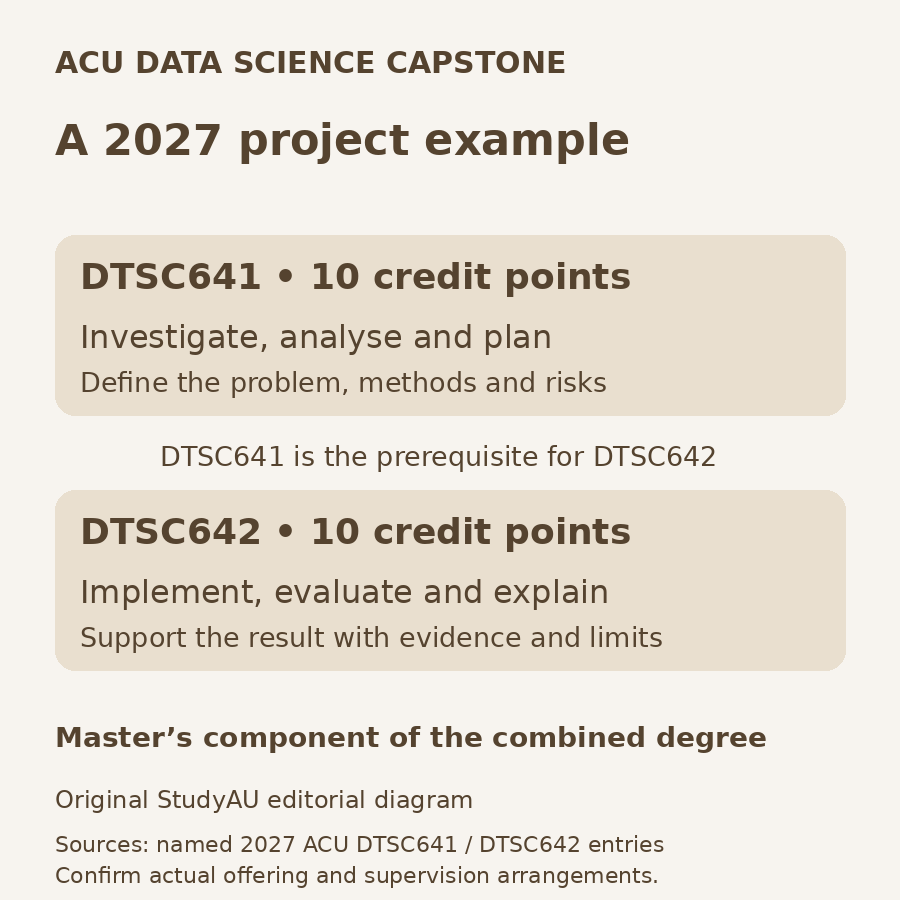
The workshop introduces the Bachelor of Computer Science and Master of Data Science together. A concrete example of assessed project work appears in the 2027 master’s component of that combined degree: the two 10-credit-point units DTSC641 and DTSC642. Their rules should not be transferred to every undergraduate project or every ACU computing course.
From investigating a problem to explaining a result
The 2027 DTSC641 entry describes an initial stage of investigation and planning. Students examine relevant literature, define a problem, undertake preliminary analysis and prepare the approach for a subsequent project stage. Technical choices sit alongside ethical considerations, resources and risks.
The DTSC642 entry then addresses carrying out, evaluating and communicating the project. It names DTSC641 as its prerequisite. A functioning output is therefore only part of the academic task: students also need to explain their methods, interpret the findings and evaluate limitations.
These are unit descriptions and requirements, rather than a promise of a named company project or an identical topic for every student.
What the named 2027 assessments require
The unit entries set out different assessment sequences:
| Unit | Assessment sequence and weighting |
|---|---|
| DTSC641 | Literature and problem review: 20%; preliminary analysis report: 30%; methodology and project plan: 50% |
| DTSC642 | Progress report: 10%; implementation and results report: 60%; final report and presentation: 30% |
For DTSC641, the entry specifically says students must pass the final planning assessment to pass the unit. It also requires achievement of every learning outcome and an overall mark of at least 50%. DTSC642 states the learning-outcome and minimum-50% requirements. Do not assume that the planning task’s additional pass requirement automatically applies to every assessment in another unit.
Both entries describe supervision and checks of students’ understanding and authorship. Follow the applicable assessment brief and supervisor’s directions. A workshop reference to generative AI does not itself establish permission to use a particular AI tool in an assessment.
Where responsible judgement becomes visible
The workshop’s Data Science section places ethical considerations alongside generative AI and responsible automation. In the named project units, that broad theme has a practical counterpart: the planning stage considers ethical implications and risks, while the later stage evaluates the reliability, limitations and implications of the findings.
As general project-reflection prompts, consider:
- Who could be affected if the output is wrong or misunderstood?
- Which data and materials may the project use?
- What evidence supports the result, and what remains uncertain?
- How will the limitations be explained to the intended audience?
These prompts are suggested ways to think about a project, not extra ACU assessment conditions or a substitute for its rubric. They also do not imply that every project uses AI.
A portfolio should explain the contribution
The workshop links practical projects with building a portfolio. As general portfolio advice, make the problem, your own contribution, decisions and limitations understandable. Check the applicable arrangements before publishing material involving another person or organisation; academic submission is not automatically permission for unrestricted public release.
A portfolio can demonstrate reasoning and responsibility, but its existence does not guarantee employer endorsement or a job offer. Likewise, the workshop’s references to business, healthcare and government challenges do not reserve a preferred sector or client for an individual student.
Confirm the actual project arrangements
At the time of checking, both 2027 unit pages listed no current unit offerings. Their curriculum and assessment descriptions should therefore be read alongside confirmation of the applicable enrolment sequence, availability and supervision arrangements. That display alone does not establish that the combined degree has been cancelled.
For the broader subject content, see the master’s curriculum guide; the purpose here is to distinguish a project’s technical output from the evidence, evaluation and communication required around it.
Sources: ACU’s official computing workshop, slides 3, 4 and 8; the named 2027 DTSC641 and DTSC642 unit entries, checked on 17 October 2026. The unit example is specific to the master’s component identified above. Individual project allocation, all linked policies and current AI-tool permissions have not been established by these descriptions.