2026-10-17
ACU nursing study: classroom learning, simulation and clinical placement
How classroom learning, simulated wards, online activities and clinical placement fit together in ACU’s nursing workshop, and what the overview does not tell you about a weekly timetable.
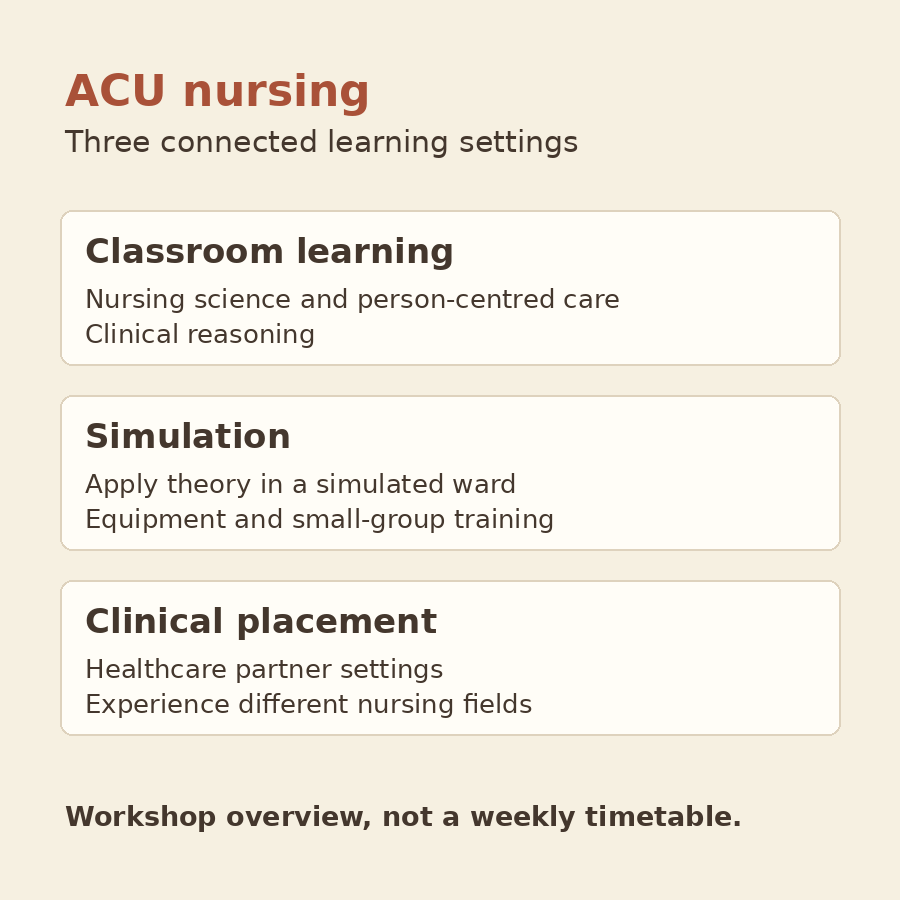
Studying nursing involves more than attending lectures or learning a set of practical tasks. ACU’s 2026 nursing workshop describes a combination of classroom learning, simulation and clinical placement. Each is part of the learning experience, but a simulated ward and a placement in a healthcare setting are not interchangeable.
The workshop also lists tutorials, laboratory and simulation training, online exercises and independent online learning. For applicants, the useful question is how these formats contribute to learning, rather than how many days on campus can be inferred from their names.
What connects the classroom to practice?
Slide 5 identifies nursing science, person-centred care and clinical reasoning as areas of study. Alongside that learning, it describes applying theory in simulated wards, using equipment and small-group training. Clinical placement offers experience of different nursing fields through ACU’s healthcare partner network.
This presents a connection between learning about care, practising in a simulated setting and experiencing clinical environments. It does not provide a timetable showing when each element occurs, or promise that every classroom topic is followed immediately by a matching simulation and placement.
The distinction matters when comparing courses. A description of facilities tells you something about the learning environment; a teaching plan tells you how that environment will be used in a particular unit. The workshop gives the broad model, not a unit-by-unit schedule.
What does simulation mean in this overview?
The workshop describes simulated wards as places to apply theory. It also refers to small-group training, but gives no numerical class-size limit. Applicants should not turn that wording into a guaranteed staff-to-student ratio or assume that every practical session uses the same equipment.
Simulation should also be kept distinct from clinical placement. The separate ACU placement-hours guide explains the workshop’s year-by-year allocation. The presentation lists both, rather than describing simulation as a substitute for all placement experience. It does not identify a particular ward, patient group or hospital that every student will attend.
Knowing that simulation is part of the course is therefore a starting point. The relevant unit information is needed to understand what students prepare beforehand, what participation involves and how learning is followed up.
Online activities do not establish an online degree
Slide 7 lists lectures, tutorials, laboratory and simulation training, online exercises, and independent online learning. The inclusion of online work does not mean applicants can complete every part of the course remotely.
Nor does a list of five formats mean five separate weekly appointments. The workshop does not state their frequency, duration or distribution across semesters. Those details cannot be calculated from the slide.
As general study preparation, students can use the instructions for a particular activity to identify what to read, what questions to bring and what to revisit afterwards. That is a suggested learning habit, not an ACU-mandated preparation checklist or an estimate of weekly study hours.
What should applicants ask next?
Before making regular work or travel commitments, obtain the timetable and attendance information relevant to the course, campus and intake. Useful questions include how laboratory and simulation sessions are scheduled, where required preparation is explained, and how online activities fit alongside attendance in person.
The workshop supports a clear conclusion: ACU presents nursing learning as a combination of academic, simulated and clinical experiences. It does not settle an individual student's attendance pattern, access to a particular facility or placement allocation. Confirming those details is the next step, rather than assuming that one teaching format describes the whole degree.
Sources: ACU’s official 2026 nursing workshop, slides 5 and 7. The presentation also lists the Bachelor of Nursing course page among its official references.