2026-10-17
ACU nursing assessments: theory tasks, simulation and clinical placement
ACU’s nursing workshop distinguishes theory assessments from clinical assessment in simulation and placement. Learn what the listed formats mean without assuming marks, dates or pass rules.
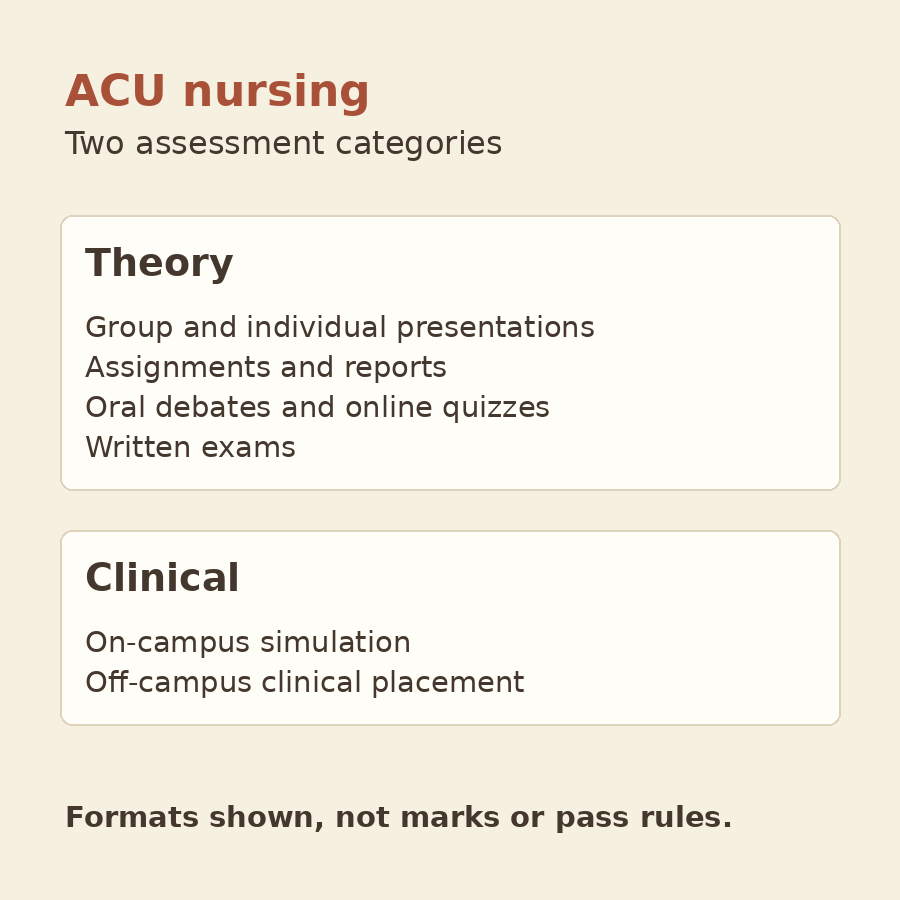
Written exams are only one of the assessment formats listed in ACU’s 2026 nursing workshop. The Bachelor of Nursing assessment overview separates theory assessment from clinical assessment, with communication, written work and practical settings all represented.
That distinction is useful for applicants deciding what studying nursing will involve. Preparing for the degree cannot be reduced to preparing for a single kind of test. The workshop identifies the formats, but does not provide an assessment schedule or grading scheme for individual units.
Theory assessment includes more than written exams
Slide 8 lists the following under theory assessment:
- Group and individual presentations.
- Assignments and reports.
- Oral debates.
- Online quizzes.
- Written exams.
The inclusion of presentations and debates shows that “theory” is not used here to mean written work only. Applicants should be prepared to encounter different ways of presenting their understanding, including spoken and collaborative work.
This is a course-level overview. It does not say that every unit uses all five formats, that every presentation is a group task, or that online quizzes carry a particular percentage of the final mark. Those details belong in the information for the relevant unit and assessment.
Clinical assessment has two listed settings
The workshop places on-campus simulation and off-campus clinical placement under clinical assessment. They are distinct settings, not two names for the same activity. The ACU learning-formats guide explains their place alongside classroom learning.
For a prospective student, this means simulation should not be understood only as an informal practice opportunity: it also appears in the assessment overview. However, the slide does not describe the tasks students must demonstrate, the assessment criteria, who assesses them or how results are recorded.
Likewise, the existence of a placement-hour requirement elsewhere in the course overview does not explain how clinical performance is assessed. Do not assume that an hours total alone answers questions about passing, progression or completion. The applicable assessment requirements need to be checked separately.
Use the assessment brief to identify the actual task
Once the relevant unit information is available, useful questions include:
- What must be submitted, presented or demonstrated?
- If a task involves a group, what is expected from each person?
- Which criteria will be used, and where are the instructions explained?
- What dates and submission or attendance arrangements apply?
- Are there specific requirements that must be satisfied independently of an overall mark?
These are general checking questions, not a claim that ACU imposes the same conditions in every unit. Asking about a separate requirement does not establish that one exists.
Preparation should follow the actual task. As general study advice, a written report calls for attention to its argument and required evidence; an oral presentation also needs preparation for explaining that reasoning aloud. For clinical assessment, use the instructions provided for the relevant learning setting and ask for clarification where needed.
What the overview cannot settle
The workshop supplies no assessment weights, exam dates, pass marks, resit rules or fixed number of clinical assessment tasks. It therefore cannot support a calculation of how many marks a student can lose, or a promise that strength in one assessment will compensate for another.
Use the overview to understand the range of assessment, then obtain the unit-specific details before planning preparation. It is a guide to the kinds of work involved, not an individual assessment plan or a guarantee of progression.
Sources: ACU’s official 2026 nursing workshop, slide 8. Its reference slide includes the Bachelor of Nursing course page for further course information.