2026-10-17
ILSC junior camps
Understand ILSC’s junior camp scope for ages 12–17 in Brisbane and Perth, including homestay and what the workshop activity calendar does not confirm.
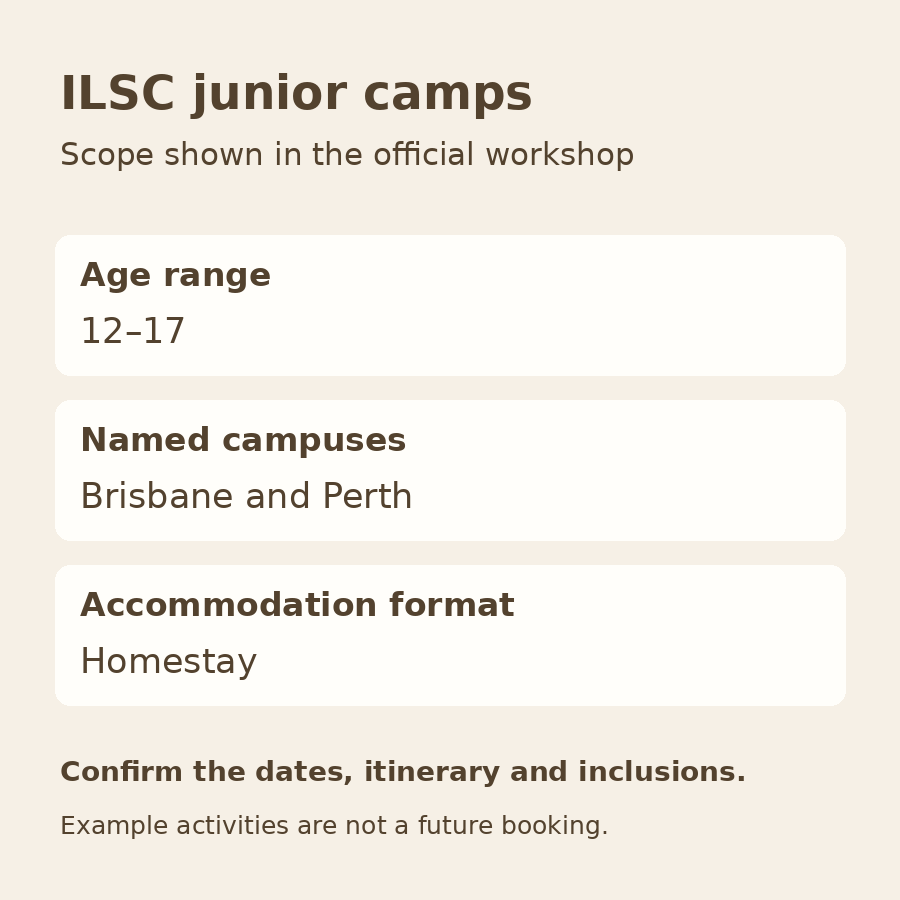
ILSC's official 2026 Australia workshop presents junior camps for ages 12–17 at its Brisbane and Perth campuses, with homestay accommodation. Those details define the offering shown in the material. They do not confirm a particular departure date, available place or price for an individual family.
For parents comparing a junior camp, the next step is to understand how lessons, activities, accommodation and supervision fit together. The workshop supplies a useful outline, but several arrangements still need to be established before a booking can be evaluated properly.
Keep the junior programme's scope distinct
Slide 13 identifies the age range as 12–17 and names Brisbane and Perth. It should not be expanded into a claim that the same junior programme runs at every ILSC campus.
The homestay description also matters. This is not evidence of a residential camp in which all students stay together on a campus. The slide does not set out room-sharing arrangements, meals, host-family matching or the journey between the homestay and school.
Those are practical questions to resolve for the specific programme. The material does not establish that every accommodation preference can be met or that every family will receive the same arrangement.
What the sample activity calendar shows
Slide 14 shows a four-week calendar of afternoon activities and full-day Saturday outings. Its entries include English lessons, art activities, sports and off-site visits. Named examples include a UQ campus tour, Sea World, indoor climbing, bowling and Australia Zoo.
These entries show the kinds of activities included in the workshop calendar. They are not a guarantee that a future camp will visit every named attraction. A campus tour is also an activity, not university enrolment or an admission pathway.
The calendar displays day numbers but no month or year. It therefore cannot establish the dates of a future intake. Nor should a four-week display be turned into a rule that every participant must enrol for exactly four weeks.
Because it is an afternoon-activity calendar, it does not provide a complete weekly teaching timetable. Families should avoid calculating a camp's total English tuition from that image alone. The calendar should not be assumed to apply unchanged to Perth simply because Perth is named on the preceding slide.
Ask how the day is supervised
As general planning questions, establish who is responsible for students during classes, activities, journeys and time at the homestay. Ask how attendance and collection arrangements work, who a parent should contact about a concern and what happens if an activity changes.
For an off-site or full-day activity, clarify what the programme includes and what the student needs to bring. If an activity has individual participation requirements, those should be explained for the actual itinerary rather than inferred from a photograph or attraction name.
The workshop pages do not state a supervision ratio, curfew, airport-transfer arrangement or parent communication schedule. None should be assumed from the word “camp”.
Compare the confirmed package
Before comparing prices, obtain the dates and inclusions for the programme being considered. Keep teaching, activities, accommodation, meals, local transport and arrival arrangements separate in your comparison. This is a suggested checklist, not a claim that all of those items are included in ILSC's fee.
The two slides do not provide a price, cancellation conditions or a live availability list. A useful comparison needs those details alongside the student's age and the chosen campus.
The workshop establishes a junior offering with named locations and a homestay format. A family's decision should then rest on the confirmed arrangements for that child and intake, rather than treating the presentation's activity calendar as a complete camp plan.
Source: ILSC's official “6.ILSC AUS 2026 -ACU.pptx”, slides 13–14. Age, campuses and homestay come from slide 13; the activity examples and calendar limits come from the actual image on slide 14. The family-planning questions are general guidance, not additional published camp terms.