2026-10-17
ILSC HELLO online study options
Compare ILSC HELLO’s five-, 15- and 20-hour online options by core and elective content, timetable questions and pathway recognition limits.
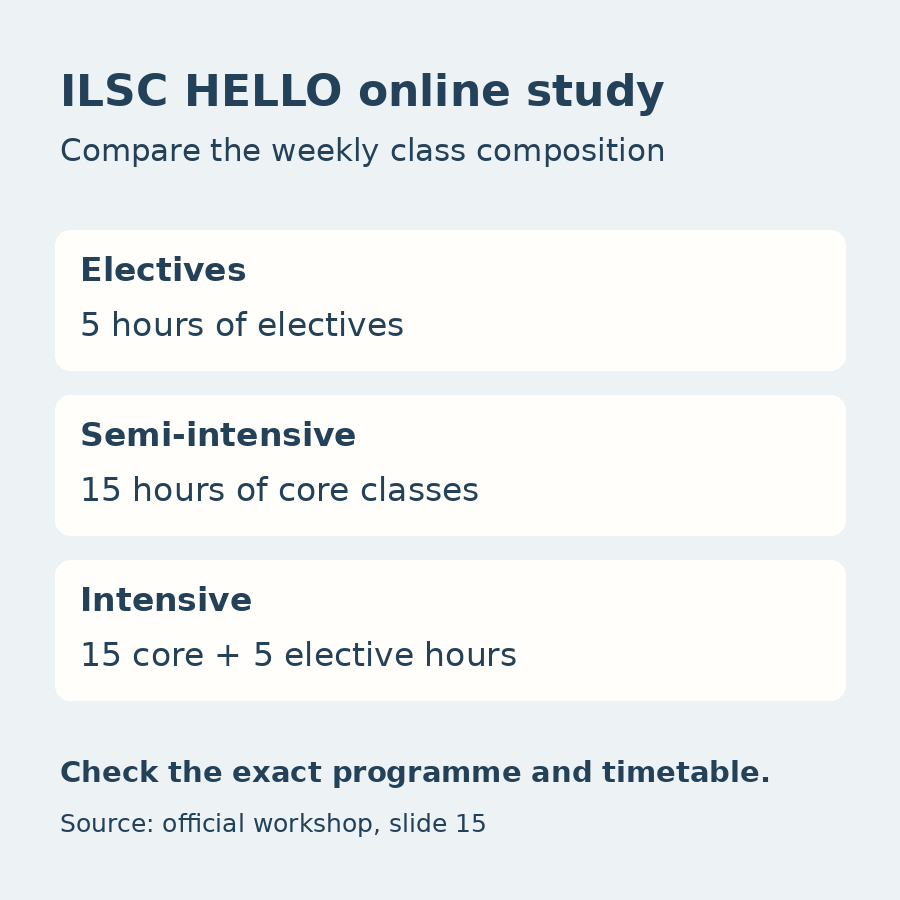
ILSC HELLO offers more than one online study load in the official 2026 Australia workshop. The presentation describes three options: five hours of electives, 15 hours of core study, or a combination of 15 core hours and five elective hours each week.
Those options differ in both time commitment and class composition. Choosing the smallest number of hours is not necessarily choosing a shorter version of the same programme. First establish what you want to study, then compare the weekly arrangement that supports that purpose.
What the three options contain
The workshop describes the options as follows:
- Online electives: five hours of elective classes per week, described as one hour a day.
- Semi-intensive online study: 15 hours of core classes per week, described as three hours a day.
- Intensive online study: 15 hours of core classes plus five hours of electives per week, described as four hours a day. The two components total 20 hours weekly.
The difference between the semi-intensive and intensive options is therefore the additional elective component in the presentation. The five-hour option, by contrast, is described as electives, not as the same core programme compressed into fewer hours.
These are the workshop's stated teaching arrangements. They do not establish how much independent practice every student needs, how quickly a student will progress or how long an individual enrolment should last.
Choose a study direction as well as a workload
Slide 15 lists General English, Academic English, University Pathway and Greystone College Pathway as study directions. It does not show a complete matrix matching every direction to every weekly-hour option.
Avoid assuming that selecting five elective hours gives access to the same pathway arrangement as a core-based course. If a particular destination is your goal, identify the exact programme and the required form of study before deciding that the lightest workload is sufficient.
For a general language-learning goal, a useful question is which skills the proposed core or elective classes address. For a pathway goal, the question also includes what completion evidence is required and whether the destination accepts that specific online route. These are different decisions even when both courses are delivered online.
Clarify the timetable in your own time zone
The slide mentions two scheduling choices but does not give their clock times or time zone. It cannot tell you whether a particular option fits around your existing commitments.
Before planning your week, establish the actual days, start and finish times, and the time zone used for the timetable. Ask whether participation is required at set times, what happens if a class is missed and what technology is needed. The workshop does not supply those details or promise that recordings can replace attendance.
As general planning advice, reserve a realistic study setting as well as the stated class hours. A quiet place, a reliable connection and time to prepare can matter when comparing an online option with your daily routine. These are personal planning considerations, not additional hours or equipment specifications mandated by the slide.
Keep online availability separate from recognition
The presence of University Pathway in the HELLO overview does not establish that every university, every degree or every intake accepts every online option. The slide does not identify institution-specific final levels, minimum study periods or conditions for using online completion evidence.
Keep the destination course, the chosen HELLO programme and the accepted evidence together when checking your plan. Do not assume that a campus-based pathway condition automatically applies unchanged online, or that a weekly-hour choice guarantees admission.
For a practical comparison, record four things: the classes included, the weekly load, the timetable in your local time and any destination-specific conditions. That produces a clearer decision than comparing five, 15 and 20 hours without considering what those hours contain.
Source: ILSC's official “6.ILSC AUS 2026 -ACU.pptx”, slide 15, covering HELLO's weekly core/elective arrangements, two scheduling choices and listed study directions. The timetable and recognition questions above are general guidance; the source does not resolve those individual conditions.