2026-10-17
ILSC Australian campuses and classroom mix
Compare the Australian campuses shown in ILSC’s workshop while keeping nationality percentages separate from future classroom mix and teaching quality.
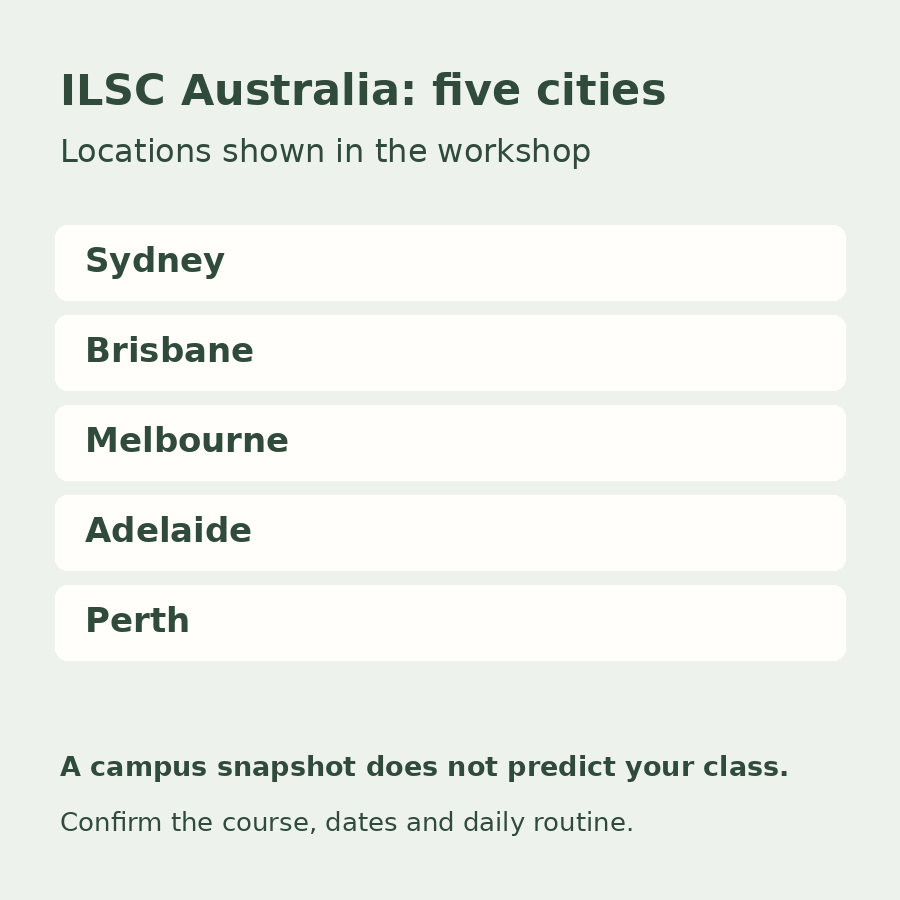
ILSC's official 2026 Australia workshop identifies Sydney, Brisbane, Melbourne, Adelaide and Perth in its Australian campus material. It also provides a campus-by-campus nationality table. Together, those pages offer a starting point for comparing locations, but they do not predict who will be in an individual student's class.
A useful campus decision considers the study option available, the practical daily routine and the opportunities to use English. A nationality percentage cannot answer all three questions, and it should not be used as a rating of students or teaching quality.
Start with the Australian locations shown
The destination map on slide 2 names five Australian cities: Sydney, Brisbane, Melbourne, Adelaide and Perth. Slide 3 gives Perth a separate visual introduction.
Those pages establish the locations being presented. They do not provide a complete comparison of course availability, class schedules, building facilities or accommodation at each campus. The Perth images should not be used to invent classroom capacities, opening dates or amenities that the slide does not specify.
For a shortlist, first identify which campus offers the study option relevant to your goal and intended dates. Then consider how the class schedule would fit with accommodation and transport. These are general selection questions, not a claim that the workshop confirms identical offerings across all five cities.
Treat the nationality table as a snapshot
Slide 11 reports different mixes across the five campus columns. For example, the Brazil category is shown as 21% for Sydney and 34% for Adelaide. These are figures in the workshop table, not a forecast of a future intake or a promised composition for a class.
The slide does not state a collection date, headcount, class-level breakdown or detailed counting method. Its percentages should therefore remain attributed to the workshop snapshot. Do not relabel them as today's verified figures or use them to calculate a student headcount without a denominator.
The table also combines country labels with broader regional and grouped categories. It is not a simple count of distinct nationalities. That matters if someone tries to turn it into a diversity ranking: the source does not provide a consistent country-by-country measure for that purpose.
Campus composition is not a classroom guarantee
A percentage for a campus does not establish the same percentage in every class. The table does not break students down by course, level, timetable or start date. It also does not record which languages students use during lessons or outside class.
Nationality alone cannot tell you a person's first language, English ability, willingness to participate or learning needs. A campus with a particular nationality mix should not be advertised as inherently better or worse on that basis.
If your concern is having regular opportunities to speak English, ask about the actual learning environment: the class format, how discussion is organised and the activities available for your study period. Those questions address the experience you want more directly than trying to select classmates by a percentage table.
Compare the conditions you can act on
A practical comparison can keep three questions together:
- Is the intended course or class available at the campus for the proposed dates?
- Can the accommodation, journey and timetable work as a daily routine?
- What opportunities would you have to participate and practise English?
Treat the answers as campus- and enrolment-specific. The workshop does not supply current rent comparisons, commuting times, class-size guarantees or a universal activity schedule, so none should be inferred from the city names or images.
The nationality table can help you understand that campus populations differ. It cannot promise a particular classroom mix or learning outcome. Choose a location using the confirmed study arrangements and a realistic personal plan, with the demographic snapshot kept in its limited role.
Source: ILSC's official “6.ILSC AUS 2026 -ACU.pptx”, slides 2–3 and 11. The Australian destinations and Perth introduction come from the map and campus imagery; the percentages are from the workshop nationality table. The comparison questions are general guidance, not a campus ranking.