2026-10-17
ACU’s social and environmental sustainability degree: structure and study focus
Explore ACU's three-year sustainability bachelor's degree: Melbourne international entry, its 240-credit-point structure, Arts minor options and community engagement.
Australian Catholic University's Bachelor of Social and Environmental Sustainability approaches sustainability through the relationship between people, institutions and the environment. For international students considering 2027 entry, it is a three-year full-time, 240-credit-point degree at Melbourne, rather than a purely technical environmental science course.
The central question is how societies can respond to environmental challenges while considering human needs, equity and justice. That makes the degree worth considering for students interested in the social dimensions of sustainability, not only the physical processes behind environmental change.
What does the interdisciplinary approach mean?
ACU's Shantou workshop describes a course bringing together humanities, environmental perspectives, business, law and philosophy. The curriculum context includes environmental humanities and economics, geography, environmental sociology, sustainability and research methods.
These areas offer different ways to examine a shared issue. As an illustration, a question about urban development can involve the use of land, the distribution of costs and benefits, community participation and the values behind a policy decision. That example explains the interdisciplinary approach; it is not a promise of a particular ACU assignment or project.
The degree's identity matters when comparing courses. A student principally seeking engineering design, laboratory-intensive environmental science or a regulated professional qualification should not assume that a sustainability title provides the same training. Here, the social and humanities perspective is a substantive part of the course, not an optional addition to a technical degree.
How the 240 credit points are organised
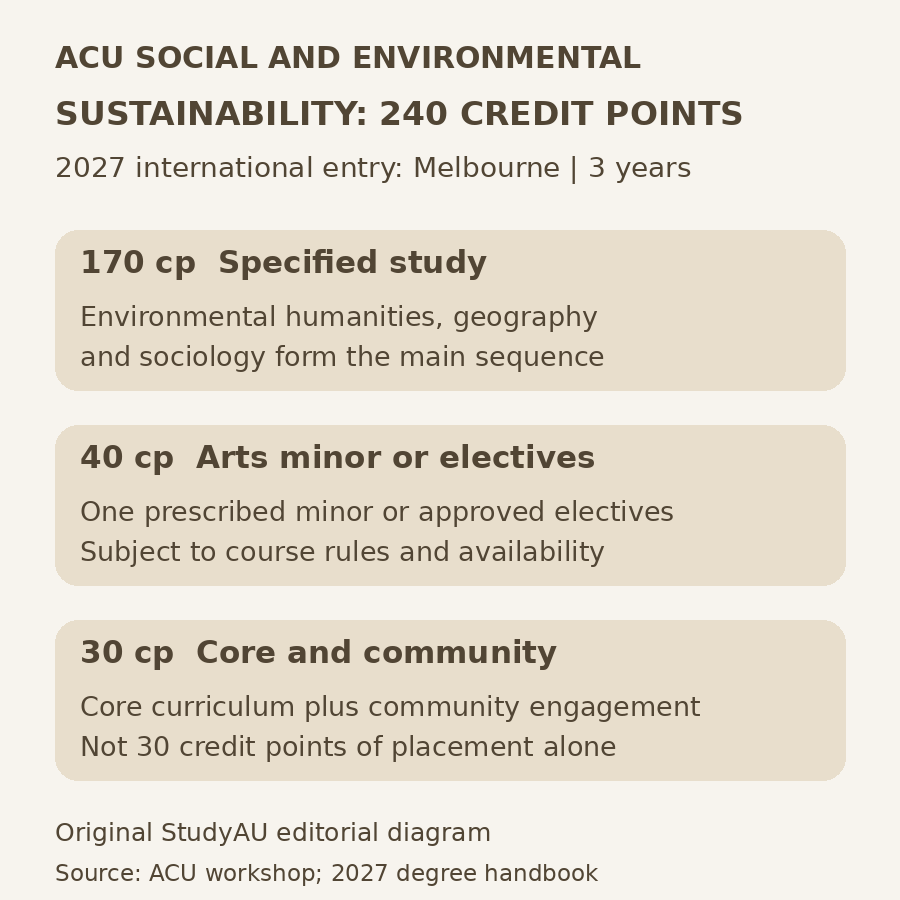
The 2027 handbook divides the course into:
- 170 credit points of specified units.
- 40 credit points in an Arts minor or electives.
- 30 credit points of core curriculum and community engagement.
Together, these components make up the 240 credit points required for the degree. The specified units provide the main course sequence, while the minor or elective component creates room for a complementary interest. For example, Environmental Humanities and Environmental Economics sit alongside Exploring Human Environments and Introduction to Sociology in the Semester 1 commencement map. The curriculum brings different ways of examining environmental questions into the same degree; the subject labels are not interchangeable professional qualifications.
A minor is not a second major or another degree. The workshop introduces a broad range of subject areas, including geography, economics, communication, business studies, psychology, politics and international relations, and sociology. For this bachelor's structure, the relevant choice is an Arts minor or electives within the allocated 40 credit points. The broad subject list should not be presented as a menu of multiple full majors inside the degree.
For planning, choose the additional subject area by the question you want it to help you examine. Geography might complement an interest in places and environmental change; communication could complement an interest in explaining sustainability issues. These are examples of intellectual fit, not guaranteed combinations, specialisations or career outcomes. The actual unit selection must fit the course rules and available offerings.
Where community engagement fits
The workshop identifies integrated work-learning and a final-year community engagement placement. This connects the degree's discussion of human and ecological needs with a setting beyond classroom study. The handbook identifies HUMA333 Social Impact in Action as a compulsory 10-credit-point unit within the 30-credit-point core and community engagement component. That combined component also includes core curriculum: its full 30 credit points should not be described as placement alone.
It should not be read as a guarantee of a paid internship, a placement with a named employer or a job offer afterwards. Nor does the workshop's description establish a universal weekly placement schedule. When considering the workload, keep the engagement component visible alongside the academic units rather than treating it as an extracurricular activity.
ACU describes possible directions in government, non-government organisations, business and community sectors. Those are broad areas of application for sustainability-related learning, not evidence that a particular employer will recruit every graduate.
Melbourne and the tuition figure
The 2027 international course information identifies Melbourne as the international study location. A general course listing that also mentions Strathfield should not be treated as confirmation of an international place there.
The indicative first-year international tuition is AUD36,624. It is not a fixed annual rate for all three years or the full cost of living and studying in Australia. Fees are reviewed annually, and non-tuition expenses sit outside that figure. Simply multiplying the first-year amount by three would not establish a guaranteed total course cost.
Who might find the course a good fit?
The strongest fit is an interest in how environmental decisions affect communities, how institutions respond and how evidence and values shape action. The course allows those questions to be studied across disciplines while retaining a defined sustainability focus.
It does not qualify a graduate as a psychologist because a student selects psychology subjects, a social-work qualification because it includes community engagement, or an engineering qualification because it concerns the environment. Those distinctions help a student decide whether the degree matches the work they eventually want to pursue.
Source: ACU's 2026 Shantou Global Engagement workshop, 2027 international course information and the 2027 degree handbook. Course structure, available study options and individual admission remain subject to the applicable course rules.