2026-10-17
ACU Secondary Education and Exercise Science: Study and Placement Checks
Explore ACU’s Secondary Education and Exercise Science double degree, its HPE teaching focus, 2027 state-specific credit structure and international campus limits.
If your interest in exercise and sport includes helping secondary-school students learn, ACU’s Bachelor of Education (Secondary)/Bachelor of Exercise Science is a course to investigate. It combines secondary teacher preparation with exercise science and has a health and physical education (HPE) teaching focus.
The double degree appears in ACU’s secondary-teaching workshop. Its 2027 course information describes four years and 320 credit points. The teaching purpose is important: the words “Exercise Science” should not be interpreted as a promise of qualification as a clinical exercise physiologist. ACU Secondary Education/Exercise Science international course
Consider the teaching role as well as the subject interest
ACU presents this course among its secondary-teaching pathways, alongside other degrees with different disciplinary combinations. For an applicant, the useful question is whether you want exercise-related study to support a school-teaching role.
Enjoying sport and wanting to teach are related interests, but one does not automatically establish the other. As a personal reflection, consider whether you would enjoy explaining ideas, planning learning and supporting adolescents with different experiences and abilities. These are general course-fit prompts, not an ACU admission assessment.
If your main goal is clinical practice rather than school teaching, investigate the specific qualification required for that role separately. A degree name should not be used to infer a professional credential it has not established.
The 2027 structure varies by state
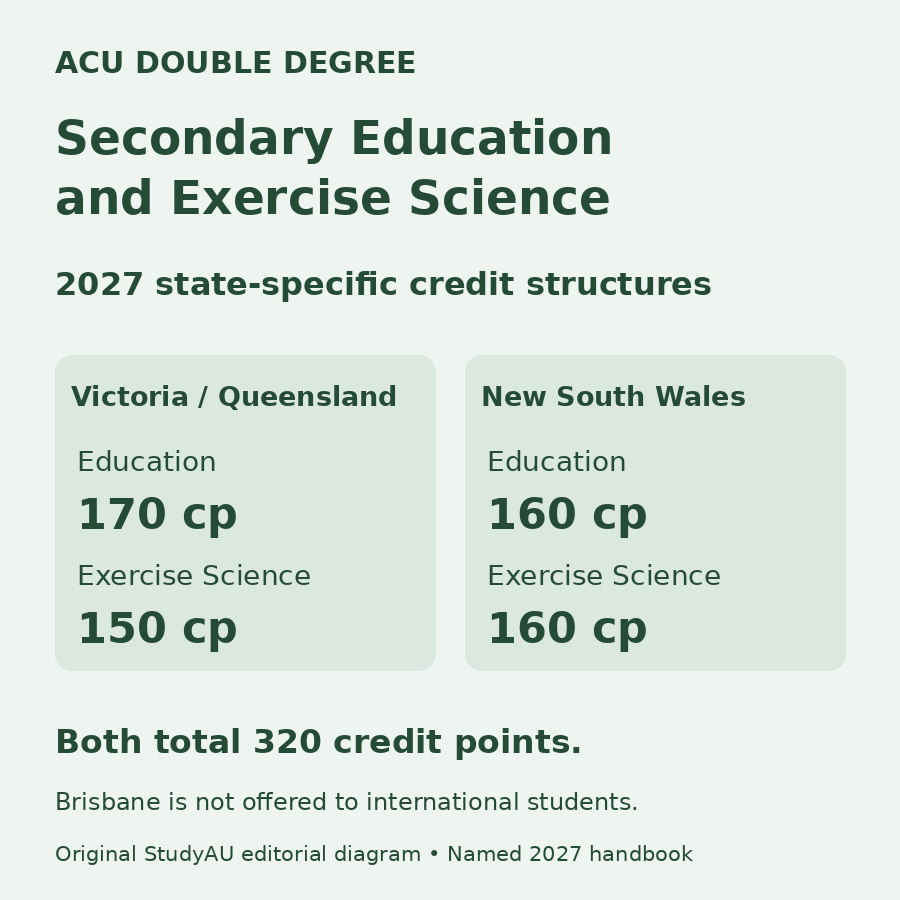
The 2027 Handbook sets out different allocations within the same 320-credit-point total:
- Victoria and Queensland: 170 credit points of Education and 150 of Exercise Science.
- New South Wales: 160 credit points of Education and 160 of Exercise Science.
Both allocations total 320 credit points. They show why the applicable state course structure matters, even when the degree name and overall duration are the same. ACU 2027 Secondary Education/Exercise Science Handbook
Use the course plan for your intended campus to check the units and permitted teaching-area arrangement. The course overview mentions another specialisation from Arts disciplines; confirm how any such option fits your applicable plan. Do not import the major-and-minor structure of the separate Secondary Education/Arts double degree. Component totals do not establish unit order or a semester timetable.
Check the international campus restriction
Brisbane, Melbourne and Strathfield are listed as approved campuses, but the 2027 information excludes international students at Brisbane. An international applicant should therefore investigate the applicable Melbourne or Strathfield option rather than treat the general three-campus list as an offer of enrolment at any location.
The Queensland structure can still appear in the handbook without making Brisbane available to international applicants. Course composition and eligibility to enrol at a campus answer different questions.
Separate teaching placements from community engagement
The course page lists EDET100, EDET201, EDET301 and EDET402 with 15, 20, 20 and 25 days respectively: 80 days in total. It separately specifies at least 25 hours of direct service or equivalent for the EXSC223 community-engagement unit. These are different requirements; community hours should not be converted into teaching-placement days. Course professional experience and community engagement
The handbook also gives progression checkpoints: LANTITE must be attempted before EDET100, and the literacy and numeracy units must be completed before EDET301. Plan these with your course adviser and enrolment guide rather than assuming they can all be left until graduation. Handbook progression requirements
Before choosing an intake, confirm academic and English entry requirements, the relevant course plan and professional-experience commitments. The figures above do not supply a personal placement calendar or school allocation, and a general campus listing does not establish individual eligibility.
Successful admission, completion of both awards and teacher registration are separate stages. This double degree should be considered for its defined combination of secondary education and exercise science, with the HPE-related teaching focus and state-specific structure understood, rather than as a guarantee of a teaching job or a clinical qualification.
Sources: ACU’s official teaching workshop, “Beyond the Classroom”, slide 8; named 2027 international course and handbook sections checked on 17 October 2026.