2026-10-17
ACU social work: what the refugee and asylum seeker role example involves
Read ACU’s workshop example of refugee and asylum seeker social work: settlement needs, service access, interpreters, advocacy, support and specialist referrals.
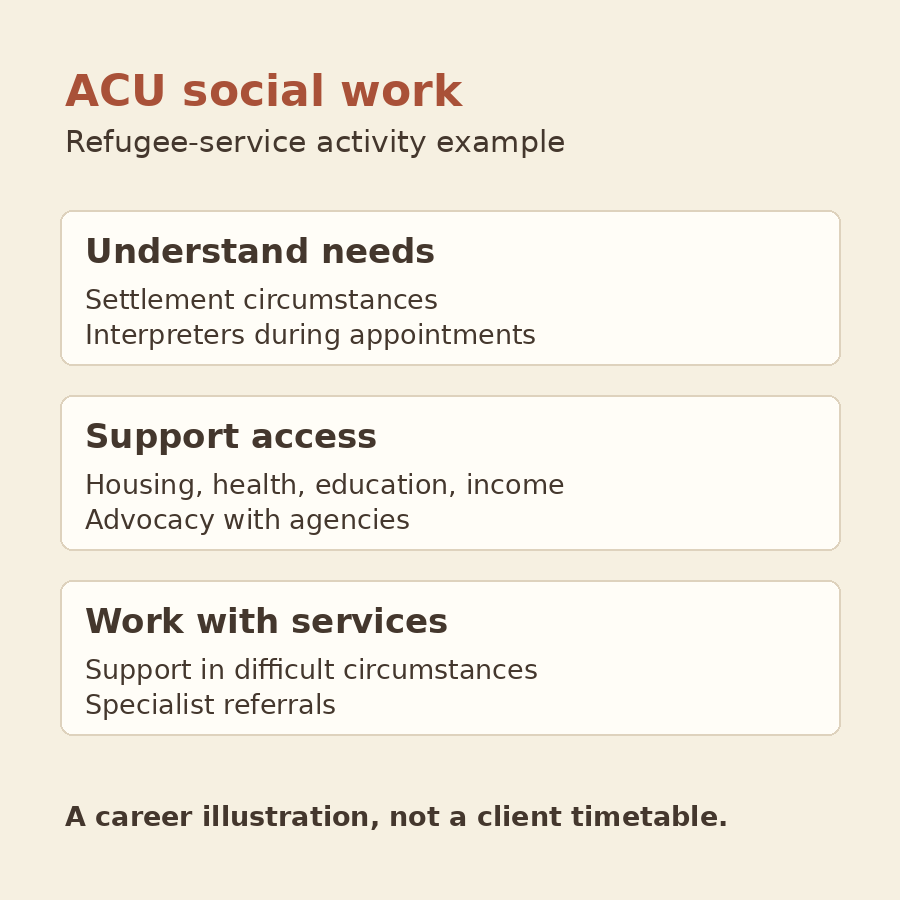
A social work career list names possible settings; a duty example shows what the work might involve. ACU's 2026 Shantou workshop gives six activities for a refugee and asylum seeker social worker. Together, they connect individual conversations with practical service access and coordination.
This is an introduction for prospective social work students. It is not a real client case, a fixed daily schedule or a promise of a refugee-service placement.
Follow the connections between the six activities
| Workshop activity | What to notice when exploring the profession |
|---|---|
| Assess settlement needs with newly arrived refugees | The starting point is the person's circumstances, rather than a standard list of needs assumed for everyone. |
| Help clients access housing, healthcare, education and income support | The example spans several service systems, rather than one type of support. |
| Work with interpreters during appointments | Communication may involve an interpreter alongside the client and social worker. |
| Advocate with government agencies about visa or service issues | Contact with agencies is one activity within the broader support role. |
| Support people experiencing trauma, family separation or uncertainty about legal status | The example includes difficult personal circumstances as well as practical access questions. |
| Coordinate referrals to specialist services | The social worker may connect a person with other services instead of providing every form of assistance personally. |
The first column paraphrases slide 12. The second offers reading prompts; it does not prescribe ACU's curriculum or an employer's procedures.
Keep service access and specialist responsibilities in view
Identifying a need, helping someone navigate a service and securing a particular outcome are different stages. The workshop does not supply service eligibility rules, allocation decisions or an interpreter-booking process. It also does not set out the qualifications or permissions required for specialist advice. Those details cannot be derived from this career illustration.
The presentation separately describes child protection and family work. Its home visits, child-safety assessments and court-report duties should not automatically be added to the refugee and asylum seeker example. A specific position's responsibilities need to be read in their own context.
Use the example to ask better course questions
If this area interests you, ask how students learn communication with interpreter support, assessment of settlement needs, referral boundaries and collaboration with services. Also ask which supervised learning opportunities are available for the actual course offering. These are suggested enquiries, not a guaranteed specialist pathway.
For the wider range of settings in the same presentation, see the ACU social work career map. That broader list and this practical example answer different questions: where social workers may work, and what some activities in one setting can involve.
Source note: The six activities come from the refugee and asylum seeker role example on slide 12 of ACU's official 2026 Shantou social work workshop. This article explains that source for course research; it does not provide individual settlement, healthcare, legal or visa advice.