2026-10-17
ACU public health after nursing: 2027 entry routes and study options
How ACU’s 2027 Master of Public Health fits a nursing background, including three entry routes, research or capstone study and conditional exit awards.
A nursing graduate considering public health is looking beyond an individual clinical specialty towards the health of populations. Australian Catholic University’s Master of Public Health takes community, national and global perspectives. The 2027 course information describes 160 credit points and a minimum duration of two years full-time or the part-time equivalent, with research or capstone pathways.
ACU’s nursing workshop includes public health among further-study directions. That makes it a relevant option to explore after nursing, but the master’s has its own entry requirements and course structure. It is not an automatic continuation of the nursing bachelor’s degree.
Three ways to meet the entry basis
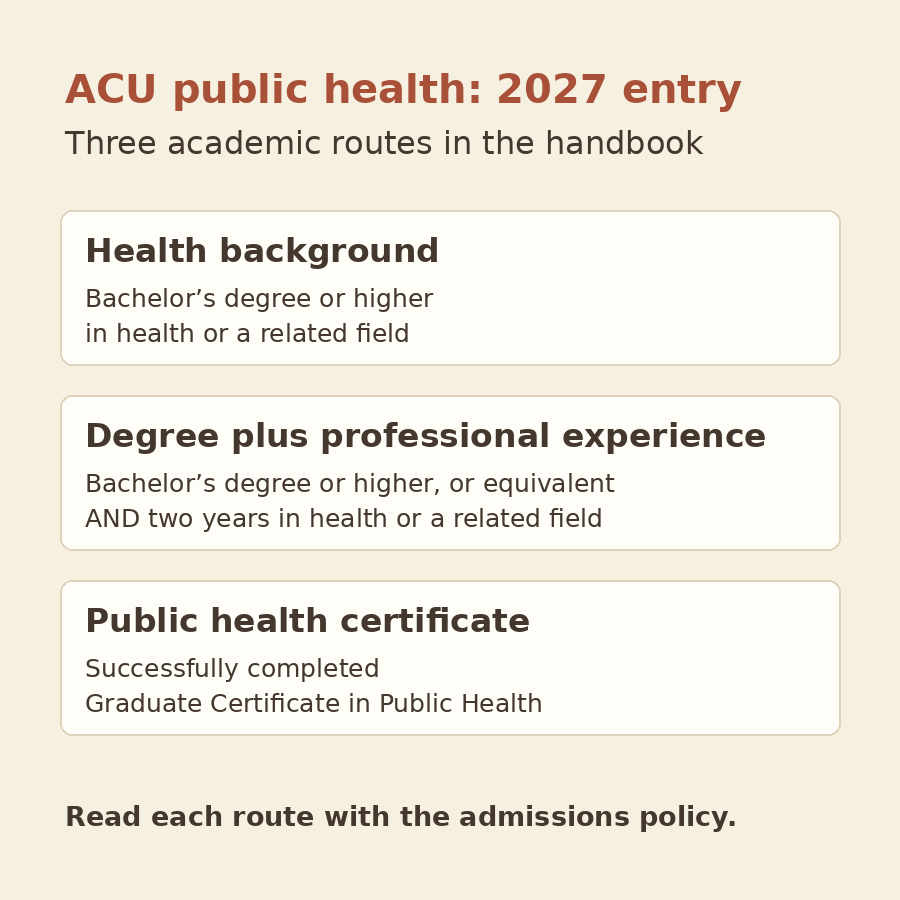
The 2027 handbook identifies these alternatives:
- A bachelor’s degree or higher qualification in a health or related field.
- A bachelor’s degree or higher, or equivalent, together with two years of professional experience in health or a related field.
- Completion of a Graduate Certificate in Public Health.
The two-year work-experience condition belongs to the second route. It should not be presented as a universal requirement for everyone, including applicants with a relevant health qualification. Conversely, an unrelated bachelor’s degree alone does not meet the second route as described.
ACU’s admissions policy also applies, including the English-language requirements for international applicants. These are academic entry routes, not confirmation of an available offering or an individual admission decision.
A nursing qualification is relevant to the health-background route. Applicants still need their qualifications assessed against the applicable admission requirements; the connection between nursing and public health does not itself amount to an offer or a credit decision.
Research or capstone: a different study emphasis
The course offers a research pathway and a capstone pathway. For someone coming from nursing, the starting question is what kind of public health work they want their further study to support: investigating a population-health question through research, or bringing learning together in a capstone project.
That comparison describes the choice at a broad level. It does not establish that every proposed topic, project partner or research arrangement will be available. The specific pathway requirements and project structure belong to the course version in which a student enrols.
This is also a shift in perspective rather than a shortcut to another clinical licence. Public health study does not, by itself, provide a new nurse or doctor registration qualification.
Exit awards require the right completed study
The course information allows a Graduate Certificate exit at 40 credit points and a Graduate Diploma exit at 80 credit points, subject to the relevant award rules. Those numbers are not an unconditional promise that any collection of units totalling 40 or 80 credit points earns the corresponding award.
An exit award and entry credit are separate matters. The exit provisions concern what a student may receive after completing the required study within the course. They do not establish that a nursing graduate starts the master’s with an automatic reduction in its 160-credit-point requirements or stated full-time duration.
For a nursing graduate comparing options, the decision therefore has three parts: whether population health fits their interests, which admission route matches their background, and whether the research or capstone pathway matches their study goals. These distinctions are more useful than treating every postgraduate health degree as another form of clinical nursing specialisation.
Sources checked on 17 October 2026: ACU’s official 2026 nursing workshop, slide 14, and its Master of Public Health course information, using the 2027 structure and entry routes.