2026-10-17
ACU nursing career settings: how ten fields relate to placements and specialisation
The nursing fields named in ACU’s 2026 workshop, from community and aged care to emergency and intensive care, and how to interpret the career list.
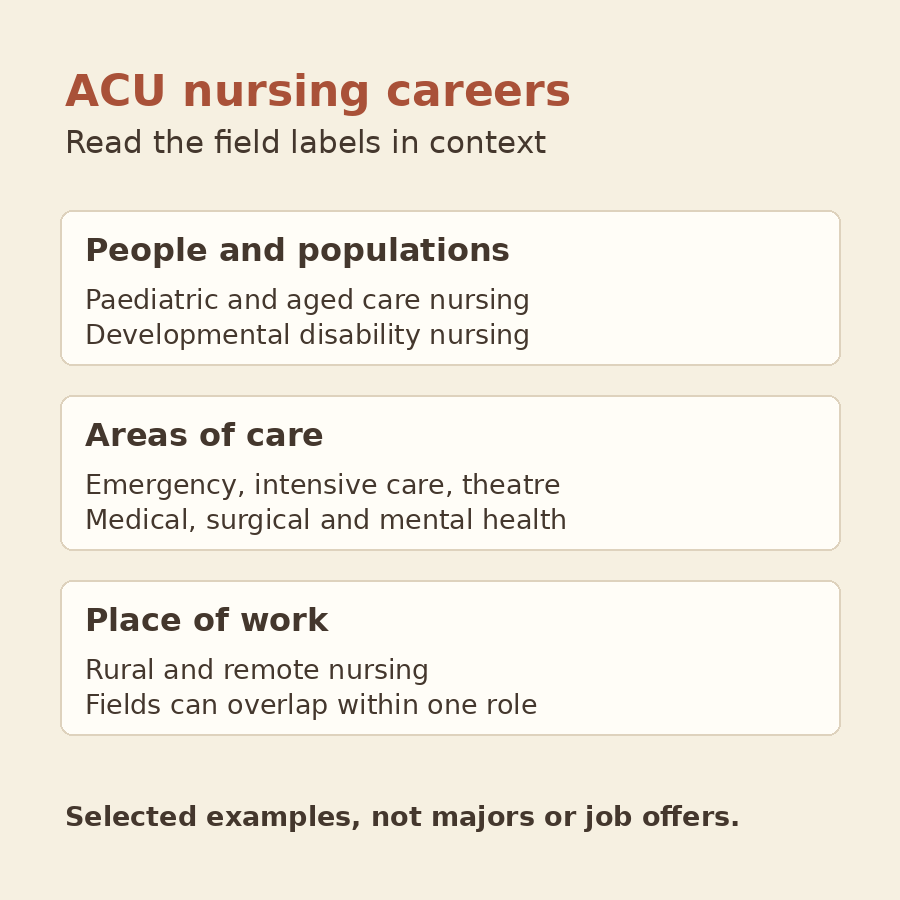
Nursing at Australian Catholic University is not presented as preparation for just one hospital setting. ACU’s 2026 nursing workshop names fields ranging from aged care and community nursing to emergency, intensive care and operating theatre nursing. For prospective students, the list is a useful way to explore interests, but it is not a list of jobs reserved for graduates.
The fields ACU identifies
The workshop names the following career areas:
- Aged care nursing.
- Community nursing.
- Developmental disability nursing.
- Medical and surgical nursing.
- Mental health nursing.
- Paediatric nursing.
- Emergency nursing.
- Intensive care nursing.
- Operating theatre nursing.
- Rural and remote nursing.
These labels describe different things. Paediatric nursing identifies a patient group; emergency nursing identifies a clinical area; rural and remote nursing identifies a geographical context. They are therefore not ten mutually exclusive career tracks. A useful first comparison is whether an interest centres on a particular population, type of care or place of work.
For example, someone interested in community nursing and someone interested in rural practice are not necessarily considering opposite directions. The workshop does not map these areas into separate undergraduate majors or prescribe a different degree for each one. It presents them as employment fields within nursing.
Career possibilities are not placement allocations
The range of fields should not be read as a promise that every student will complete a placement in every area. A career list and an individual placement schedule answer different questions: one concerns possible directions after study; the other concerns the actual learning experiences arranged during the degree.
The same distinction matters for specialist roles. Naming intensive care or operating theatre nursing does not establish that a new graduate is immediately eligible for every vacancy in those areas. The workshop does not specify employer selection criteria, additional training requirements or a timetable for promotion.
What the wider career claims mean
ACU also highlights clinical opportunities, professional recognition, pay and progression, flexibility across life stages, and interstate or overseas work possibilities. These are broad career themes, not a salary schedule or an entitlement to work in another country.
ACU’s nursing FAQ, read on 17 October 2026, gives a useful distinction: student placements span several nursing areas, while opportunities for very specialised placements are limited. It describes later specialisation after graduation if an employer offers a specialised role, or through further postgraduate study. This is a reason to check the actual opportunity rather than read the career list as an undergraduate placement entitlement.
For a course shortlist, use the named fields to identify what appeals to you. Keep the separate questions visible: the education you will receive, the requirements for professional registration, and the conditions attached to a particular job. The career overview answers the first-stage question of where nursing might lead, rather than settling all three.
Sources: ACU’s official nursing workshop dated 15 October 2026, slide 13, and the linked ACU nursing FAQ read on 17 October 2026. The FAQ supplements the workshop on placements and later specialisation; neither supplies a personal job offer.