2026-10-17
ACU GCIT to Master of IT: foundations, credit and study sequence
Understand ACU's GCIT-to-MIT pathway, how certificate entry differs from direct master's entry, and which progression and credit details belong in a study plan.
Australian Catholic University offers a Graduate Certificate in Information Technology (GCIT) that articulates into its Master of Information Technology (MIT). For someone considering a staged postgraduate route, the important distinction is between entry to the certificate, progression into the master's degree and the credit applied to the remaining study.
This is an IT-specific pathway. It should not be confused with the Graduate Certificate in Business Administration or presented as a promise that any Graduate Certificate leads to any ACU master's degree.
What the certificate involves
The 2027 international GCIT course information lists North Sydney, a full-time duration of half a year and 40 credit points. Its foundation areas include programming, databases, data science and cloud technologies. The 2027 GCIT handbook identifies four specified 10-credit-point units:
- ITEC610 Introduction to Data Science with Python.
- ITEC612 Modern Information Technology Infrastructure.
- ITEC617 Modern Database Management.
- ITEC619 Programming Fundamentals.
The certificate requires all four, rather than any four subjects with an IT title. Its published minimum duration is half a year, but the displayed Semester 1 commencement map places three units in Semester 1 and ITEC617 in Semester 2. Those two displays do not establish a personal half-year timetable. The actual sequence needs to be settled through the applicable Course Enrolment Guide and Course Adviser; a package should not be advertised with a guaranteed completion date on the strength of the headline alone.
For entry, ACU lists an Australian bachelor's-equivalent qualification in any discipline or at least two years of industry experience in a relevant role. International applicants must meet English-language requirements; the course page specifies Academic IELTS 6.5 overall, with 6.0 in each component. These are eligibility requirements, not a guarantee that every qualification or employment history will be accepted.
The GCIT course information explicitly identifies articulation into the MIT. The academic route is therefore more specific than a general claim that a short postgraduate course can replace all master's entry requirements.
Keep direct master's entry separate
For 2027 direct admission, the MIT lists an Australian bachelor's-equivalent qualification in any discipline. International English evidence remains a separate admission requirement under ACU's policy. The direct-entry listing and the certificate's articulation pathway describe different routes into study; they should not be collapsed into a single eligibility test.
In particular, the GCIT's relevant-industry-experience option is not, by itself, evidence that two years of work grants direct admission to the MIT. Conversely, the MIT's direct-entry bachelor requirement should not be used to erase the separately stated GCIT articulation route. The relevant facts are set out in ACU's 2027 MIT handbook and the GCIT pathway description.
For an applicant who already meets direct master's entry, the useful question is whether a staged route serves a real academic purpose. For an applicant relying on relevant experience, the immediate question is whether that experience meets the certificate's entry requirement, followed by the conditions attached to progression.
How the certificate relates to the master's structure
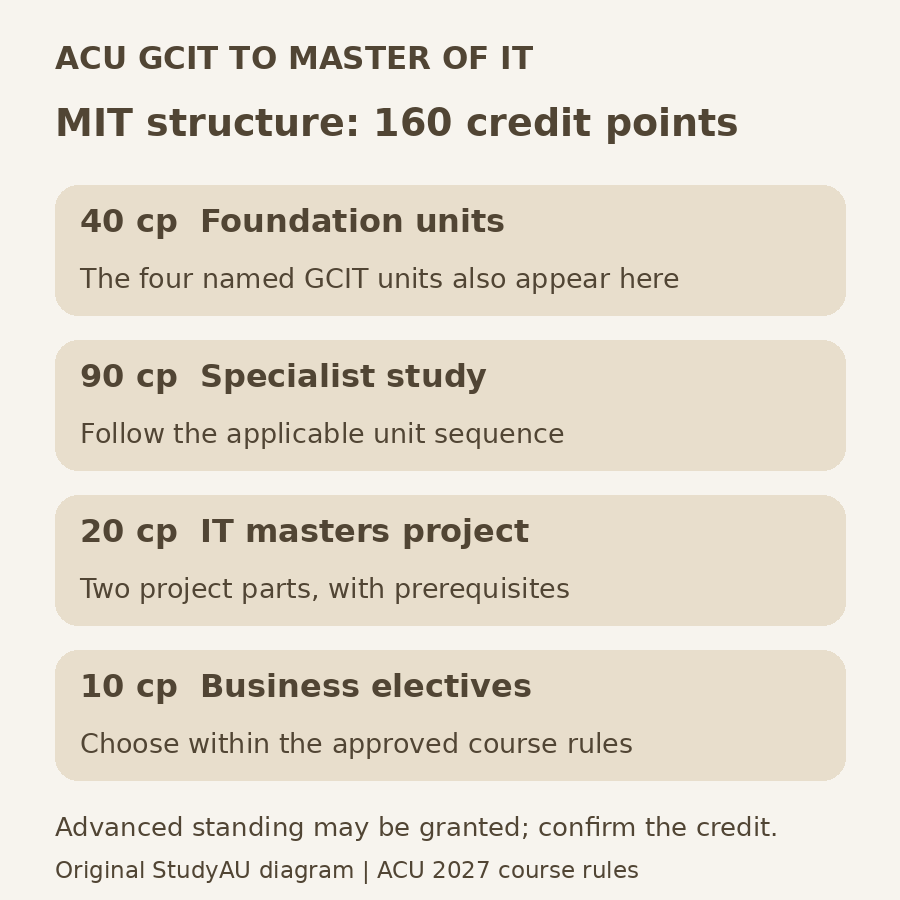
The MIT's 2027 rules specify 160 credit points, with a standard minimum full-time duration of two years. They divide the award into 40 credit points of foundation units, 90 of specialist study, 20 for the IT master's project and 10 of business electives. The four GCIT unit codes also form that named foundation group. This is a concrete connection between the awards, rather than a similarity in course titles.
The same rules say a completed GCIT may attract advanced standing. The shared unit set helps explain the pathway, but the credit decision still determines what is recognised and which MIT units remain. It does not establish a universal 40-credit-point reduction for every applicant.
Sequencing still matters after recognition. For example, the MIT map lists ITEC610 as a prerequisite for ITEC613 Machine Learning with Scikit-Learn. A prerequisite is study that must have been passed before enrolment in the dependent unit. Introductory preparation therefore has a role beyond reducing a number in a fee calculation.
The handbook excludes Blacktown, Brisbane and Melbourne from 2027 MIT delivery. That makes a generic list of ACU campuses unsuitable for constructing this year's IT pathway. The certificate's international page identifies North Sydney; it does not make every delivery location or online option an interchangeable international study arrangement.
A pathway is not yet a personalised timetable
The word “articulates” identifies a recognised connection between courses. It does not, on its own, tell every applicant the exact credit award, remaining units, progression conditions or total time to graduation.
A clear study plan should distinguish:
- The basis on which entry to the GCIT is assessed.
- The requirements for completing the certificate.
- The conditions attached to continuing into the MIT.
- Any credit formally recognised towards the master's degree.
- The remaining units and their sequence after that credit is applied.
These are planning questions, not a claim that ACU imposes an additional uniform checklist. They help prevent two opposite budgeting errors: assuming all earlier study must be repeated, or assuming that every certificate automatically removes the same period from a master's degree.
How to describe an overseas qualification or relevant role
A qualification's translated label does not settle Australian equivalence. Similarly, an IT-related job title does not fully explain the relevance of someone's work. For preparation, organise qualification and transcript details separately from employment dates, responsibilities and evidence of the work performed.
That separation is useful for diploma holders or applicants with non-standard qualification histories. It keeps a possible experience-based certificate route distinct from an unsupported claim that a particular overseas diploma is automatically sufficient. The outcome remains an individual assessment, not a blanket promise for everyone with the same broad credential name.
A sound GCIT-to-MIT plan therefore names both qualifications and makes the transition between them explicit. It does not borrow conditions from a business certificate, assume a universal package length or treat eligibility for the first stage as unconditional completion of the second.
Source context: ACU's 2026 Shantou workshop introduces postgraduate package options. The IT-specific articulation and certificate international entry details above come from ACU's 2027 GCIT course information; the linked 2027 handbooks supply the named units, master's structure and academic entry rules.