2026-10-17
ACU GCBA to MBA: course choices, admission and credit
How ACU's four-unit GCBA fits a later MBA: the 2027 course map, certificate entry, master's structure and why advanced standing is an assessed outcome rather than a fixed package promise.
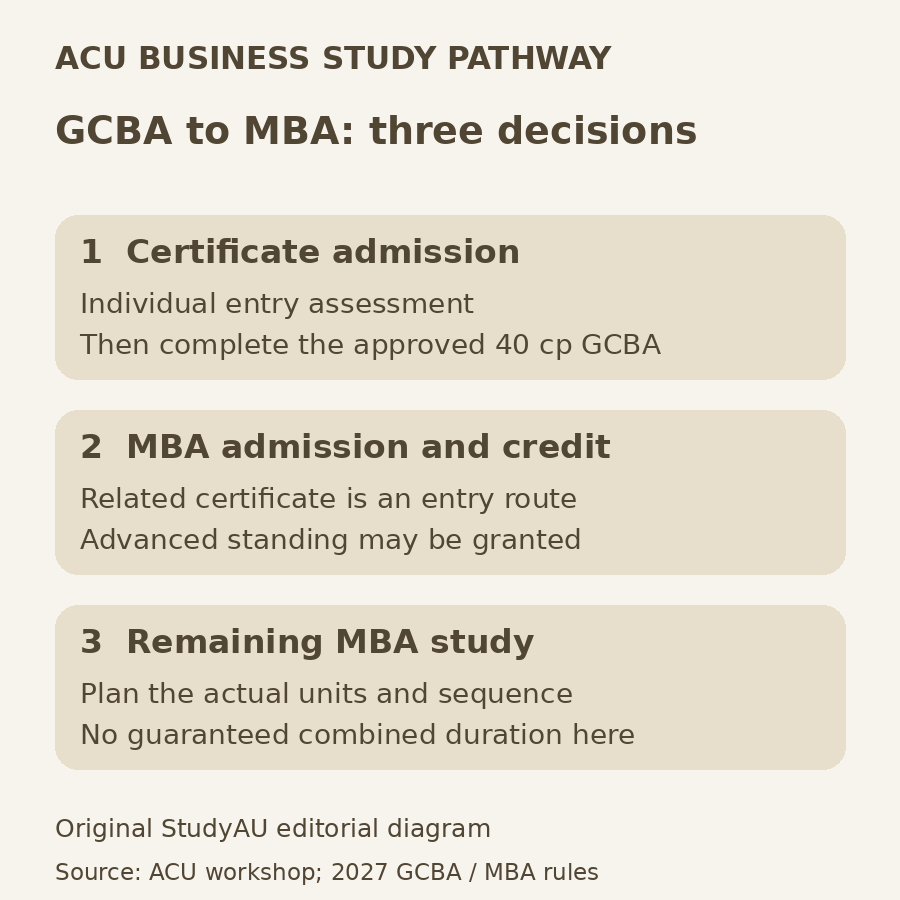
Australian Catholic University (ACU) presents its Graduate Certificate in Business Administration (GCBA) as a route into the Master of Business Administration (MBA). The practical question is not simply whether four subjects lead towards a master's degree. It is which four subjects form the certificate, how they relate to the MBA's structure, and what remains to be confirmed when moving between the two awards.
ACU's 2026 Shantou workshop describes completing four GCBA courses before progressing into the MBA pathway. Its 2027 course information supplies the detail needed to turn that outline into a study plan, without treating the outline as a guarantee of a particular combined duration.
Four units, not any four business subjects
The GCBA comprises 40 credit points, with a minimum full-time duration of half a year. The international course page lists Melbourne and North Sydney. Its published 2027 course map allocates four 10-credit-point places:
- ACCT600 Accounting for Decision Making or BUSN602 Money Management.
- BUSN609 Business Communication for the 21st Century.
- BUSN612 Managing Market Environments.
- MGMT641 Organisational Dynamics and Behaviour.
The “or” belongs to the first place; it does not make the entire certificate an unrestricted selection of four units. The handbook's wider list of unit offerings and the course map serve different purposes. Students follow the relevant Course Enrolment Guide unless a Course Adviser approves another arrangement, and maps can change. GCBA course map and rules
This distinction matters when choosing subjects for a later destination. Counting four completed subjects is not enough if they are not the subjects required by the approved study pattern. A sensible enrolment plan identifies both the unit codes and the award they are intended to support.
Who can enter the certificate?
For 2027, the GCBA lists an Australian bachelor's-equivalent qualification in any discipline, or at least two years of industry experience in a relevant role. The international English requirement is Academic IELTS 6.5 overall, with 6.0 in every component. ACU's international GCBA information also expressly identifies articulation into the MBA.
The workshop discusses applicants with three-year full-time diplomas, five-year continuous diplomas, graduation credentials without a degree certificate, and diploma or bachelor's qualifications obtained through China's higher-education self-study examination system, subject to case-by-case assessment. Those categories describe people for whom the pathway may be considered; they do not establish a uniform exemption from admission requirements. Equally, the public experience-based entry option should not be rewritten as a new rule that every workshop-listed diploma holder must have two years of experience. The individual admission basis needs to be clear.
The GCBA handbook also describes the award as an MBA exit qualification. That is not a statement that it is available only to students leaving the MBA: the same handbook provides certificate admission rules, and the course page identifies the onward pathway. An entry route and an exit award can coexist without being the same decision.
Where the certificate sits beside the MBA
The 2027 MBA has 160 credit points and a minimum full-time duration of two years. Its structure separates 40 credit points of business foundations, 80 of specified business study, and 40 of electives or an approved stream. The handbook accepts a related Graduate Certificate as an admission route and says completed GCBA or Graduate Diploma in Business Administration qualifications, or equivalents, may attract advanced standing. MBA structure and admission rules
That creates two different planning questions. Admission concerns whether the student can enter the MBA. Advanced standing concerns what prior learning is recognised within it. A positive answer to the first does not, by itself, specify the number or identity of units remaining after the second.
The two maps also show why a certificate should not simply be relabelled as the MBA's first semester. In the MBA's Semester 1 commencement map, the first four units are BUSN609, BUSN612, MGMT641 and BUSN617 Research Methods. Its ACCT600/BUSN602 choice appears in the following semester. The certificate's four-unit map groups its foundation subjects differently. Match the recognised units to the remaining MBA sequence rather than copying one timetable onto the other.
The shared business-foundation context makes the staged route intelligible, but it is not a substitute for a credit decision. In particular, “may” should not become a promise that every GCBA student receives exactly 40 credit points of MBA credit.
Avoid two shortcuts when planning the rest of the degree
First, do not add the half-year certificate and two-year MBA durations and present the result as the compulsory package length. Nor should the certificate automatically be subtracted to advertise a shorter guaranteed total. The actual plan depends on recognised study, remaining units and their sequence.
Second, distinguish an MBA stream from a different master's award. The handbook's Accounting/Finance stream is an option within the MBA, not a separate Master of Finance. It also specifies ACCT600 rather than BUSN602 for students taking the Accounting stream. This gives the initial accounting-or-money-management choice a concrete consequence for later planning.
The handbook notes that the MBA is not offered at Brisbane in 2027. A general location list should therefore not be used to construct a Brisbane package for that year.
What a useful pathway plan should show
Before treating the route as a settled timetable, the student should be able to identify the basis of GCBA admission, the approved four-unit pattern, the conditions for completing the certificate, the MBA admission arrangement and any formal advanced-standing decision. The remaining MBA units can then be placed in a sequence consistent with the applicable enrolment guide.
These are different stages of one educational plan, not extra requirements invented by the word “package”. Keeping them separate preserves the real benefit of a staged business qualification while avoiding an unsupported promise about automatic progression, total fees or graduation date.
Source context: ACU's 2026 Shantou Global Engagement workshop, its 2027 international GCBA information, and the 2027 GCBA and MBA handbooks linked above.