2026-10-17
ACU GCBA to professional accounting: ACCT600 and the MPA sequence
Why ACCT600 matters when planning ACU's GCBA-to-MPA route, how accounting prerequisites shape the next stage, and why a separate accounting exit certificate does not establish GCBA credit.
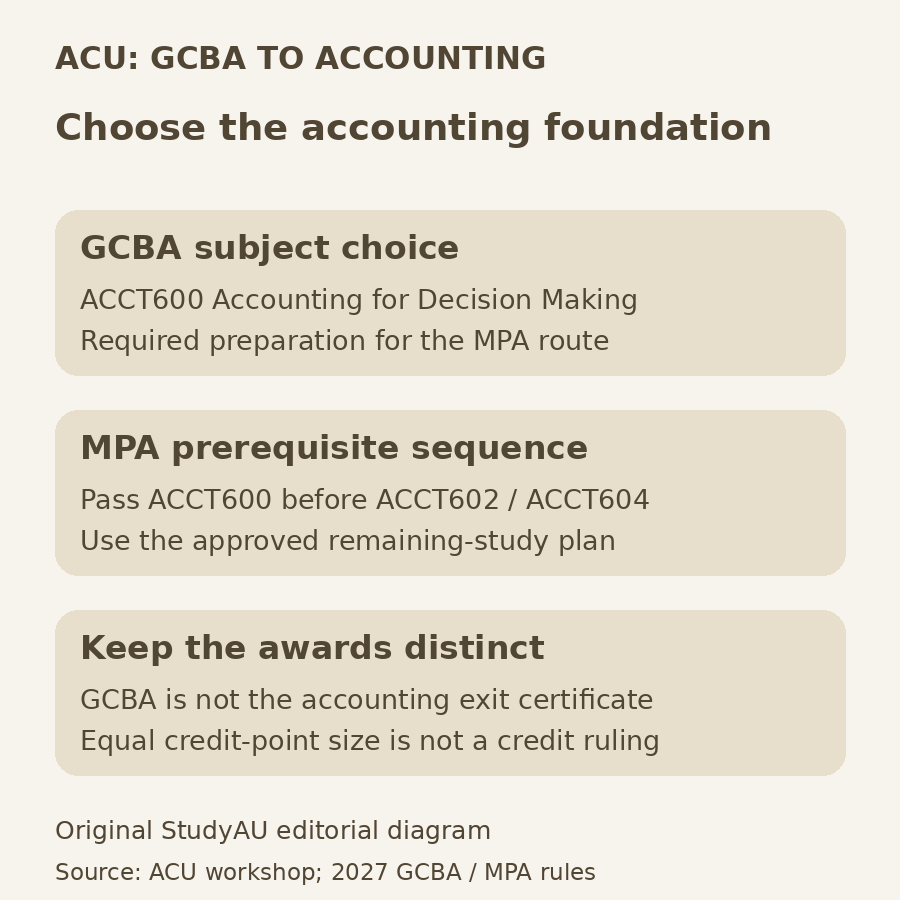
Australian Catholic University (ACU) identifies a Graduate Certificate in Business Administration (GCBA) route towards the Master of Professional Accounting (MPA) in its 2026 Shantou workshop. For someone with accounting as the intended destination, the decisive planning detail is a subject choice inside the certificate: ACCT600 Accounting for Decision Making, rather than BUSN602 Money Management.
The 2027 GCBA handbook expressly makes ACCT600 essential for students intending to study the MPA later. This is not simply the MBA pathway with a different master's name attached. The choice affects preparation for an accounting curriculum with specified prerequisite relationships.
Make the accounting destination visible in the certificate plan
The GCBA's standard 2027 map has four 10-credit-point places: ACCT600 or BUSN602, plus BUSN609, BUSN612 and MGMT641. The certificate totals 40 credit points, with a minimum full-time duration of half a year. For the MPA destination, the accounting option is the relevant branch of that first choice; BUSN602 is described as the alternative for students not pursuing an accounting career. 2027 GCBA handbook
That means “four subjects completed” is not a sufficient description of preparation for the next award. The intended master's course needs to be known while selecting the certificate units, not only after the certificate has finished. A plan that records the destination as “business or accounting, decide later” leaves a substantive subject choice unresolved.
The published enrolment pattern is not a licence to choose any four items from a longer unit list. The applicable enrolment guide and any adviser-approved variation govern the actual pattern. If the student's plan changes towards accounting, the question is whether the required preparation has been completed, not whether another subject sounds financially related.
Entry to the GCBA and entry to the MPA remain separate
For 2027, GCBA entry allows an Australian bachelor's-equivalent qualification in any discipline or at least two years of relevant industry-role experience. Its international page specifies Academic IELTS 6.5 overall and 6.0 in each component. Those are certificate requirements. GCBA international entry information
The workshop's discussion of diploma and other qualification backgrounds retains case-by-case assessment. It should not be rewritten as automatic admission for every holder of a particular overseas credential, or as a new blanket work-experience rule for all such applicants.
The MPA's 2027 entry rules separately accept an Australian bachelor's-equivalent qualification or a Graduate Certificate in a related discipline, alongside the applicable international English requirements. The workshop route and the GCBA handbook's explicit MPA subject advice give the staged plan substance, but do not remove the need to complete the relevant certificate and satisfy the master's admission arrangement.
Why the prerequisite chain matters
The MPA consists of 160 credit points: 120 in specified accounting units and 40 in electives or a permitted stream. Its standard minimum full-time duration is two years. In the course map, ACCT600 precedes ACCT602 Financial Accounting and Reporting and ACCT604 Managerial Accounting; a prerequisite must be passed before the dependent unit is taken. 2027 MPA handbook
A second sequence is visible in the same map: LEGL601 Commercial and Corporations Law must precede LEGL602 Taxation Law. BUSN603 Corporate Governance and Risk Management has a different prerequisite: completion of 30 credit points at master's level. These are different kinds of conditions; one passed introductory accounting subject does not satisfy every later prerequisite.
This makes sequencing more important than a simple count of subjects. Having enrolled in an introductory unit is not the same as passing the prerequisite. Likewise, a plan that lists all remaining subjects without checking their order may not describe a workable timetable.
The useful transition document is therefore a remaining-study plan that shows recognised prior units, outstanding prerequisites and the sequence into later accounting work. It is not enough to write “GCBA completed, subtract four subjects” at the top of an MBA-style schedule.
Do not confuse the two Graduate Certificates
The MPA handbook also describes a Graduate Certificate in Professional Accounting as an exit qualification. Its 40-credit-point requirements include ACCT600 plus 30 credit points from other specified MPA units. That is a different named award from the Graduate Certificate in Business Administration.
An exit qualification explains what an MPA student may receive after meeting that award's requirements and leaving the master's course. It is not a GCBA-to-MPA credit table. The shared 40-credit-point size does not establish that the two certificates contain the same study, or that all GCBA units are automatically credited to the MPA.
There is another easy misreading: the MPA admission rules refer to up to four units of credit for a related bachelor's qualification. That statement should not be reassigned to GCBA holders. Qualification type, unit content and the actual credit decision all matter; a number attached to one admission category cannot settle another category's entitlement.
Build the pathway around the remaining accounting study
For the proposed transition, identify the GCBA subjects actually passed, the ACCT600 outcome, the MPA admission conditions and any formally recognised credit. Then map the remaining accounting requirements in their permitted order. Neither the certificate's half-year duration nor the MPA's standard duration establishes a guaranteed combined package length or fee total.
The MPA handbook notes that Brisbane is not offered in 2027, so a general campus list should not be used to promise that location for the intended intake.
A study pathway also does not establish professional membership, practising status or employment. The decisions discussed here concern entry, recognised study and the accounting sequence; a certificate admission or credit outcome should not be presented as a professional designation.
The distinctive value of the GCBA-to-MPA route is therefore not a guaranteed shortcut. It is a staged entry plan whose accounting preparation can be identified early, beginning with the correct first subject and followed by an explicit assessment of the study still required.
Source context: ACU's 2026 Shantou Global Engagement workshop and the 2027 GCBA and MPA course information and handbooks linked above.