2026-10-17
Further study after nursing at ACU: research, clinical development or a broader health field?
ACU’s nursing workshop maps several further-study directions. Separate research training, practice-focused study and broader health interests instead of treating the awards as an automatic progression ladder.
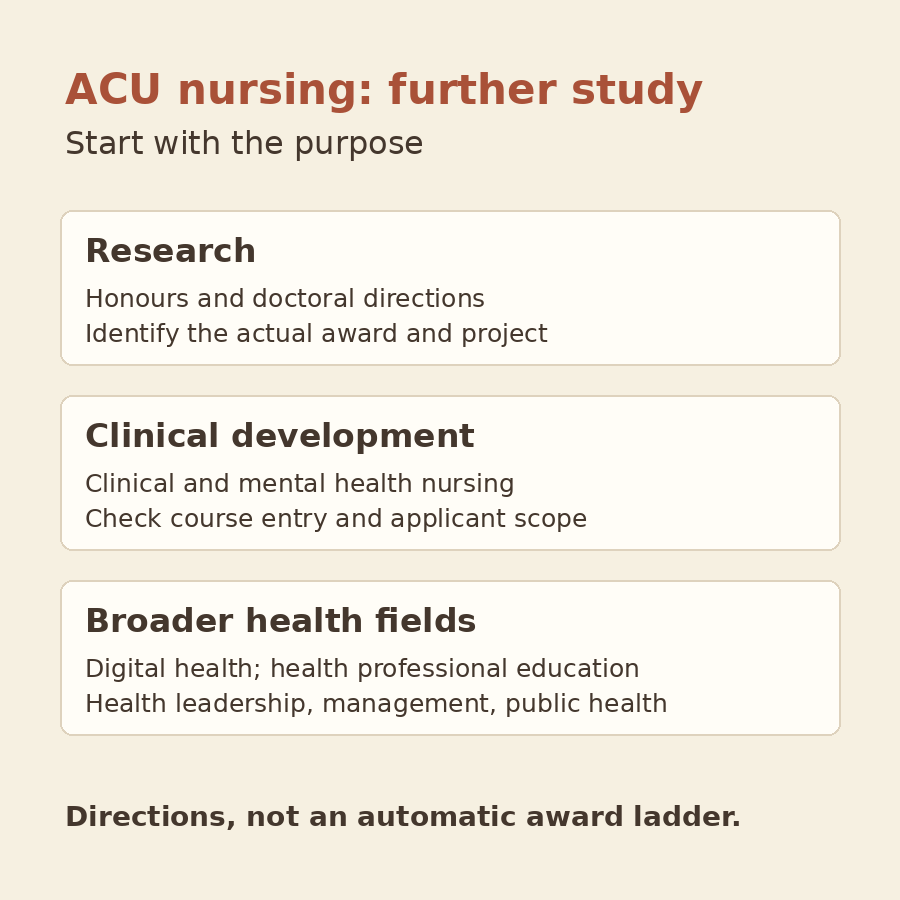
Australian Catholic University (ACU) presents further study after nursing as a set of directions, not one compulsory sequence. Its official nursing workshop of 15 October 2026 lists honours, graduate certificates, graduate diplomas, master’s degrees and doctoral study, alongside several fields of study.
The useful first decision is what you want further study to do: develop research skills, deepen a practice-related interest, or explore a broader health field. The award title alone does not answer that question, and the workshop does not establish automatic entry from one award into another.
Research training is a distinct choice
Honours appears as its own direction in the workshop. ACU’s 2027 Bachelor of Nursing (Honours) international course information makes the research emphasis concrete: a supervised thesis is central to the one-year full-time degree, which comprises 80 credit points. It does not lead to initial nurse registration.
That distinction matters for a graduate deciding between investigating a nursing question and seeking a different kind of professional preparation. Honours is not simply a shorter label for every form of postgraduate nursing study. The dedicated course has its own academic and English-language entry requirements.
The honours page connects the degree with later doctoral study. That is a study direction, not an individual doctoral admission decision. The further-study list does not supply doctoral selection requirements, supervision arrangements for an individual project or a scholarship offer.
Clinical and professional interests need a course-specific match
The workshop names clinical nursing and mental health nursing among the further-study fields. It also lists midwifery with entry after a first degree. Keep that entry-route description separate from the exact award title, rather than inferring an award level from the word “graduate”.
These labels help identify a direction, but they are not a complete admissions guide. They do not establish that every field offers a certificate, diploma and master’s award, or that the same registration and experience conditions apply across all options.
Clinical nursing illustrates why delivery mode must be separated from access. The 2027 Master of Advanced Clinical Nursing handbook lists a Bachelor of Nursing (or equivalent) or higher and current Ahpra registration among its admission requirements. It lists ACU Online, excludes offshore international students and is not for international students seeking to study on a student visa. “Online” therefore does not mean this option is open from any country.
Broader health fields are also on the map
Digital health, health professional education, health leadership and management, and public health appear in the workshop’s list. As a way of organising that list, these point towards questions about technology, teaching, services and population health, rather than only a named clinical specialty.
This is an interpretation of the subject labels, not a promise of a particular job or a claim that every nursing graduate meets the entry requirements. Each named course still needs its own qualification, delivery and applicant-scope information.
A practical shortlist can therefore start with the purpose of study, then identify the actual award and applicable year. Only after those choices does it make sense to compare entry conditions and structure. The workshop is valuable as a direction map; reading it as an automatic certificate-to-diploma-to-master’s-to-doctorate ladder would add promises it does not make.
Sources: ACU’s official 2026 nursing workshop, slide 14, and the linked 2027 course information, read on 17 October 2026. This overview does not replace the separate entry rules for each pathway.