2026-10-17
ACU Early Accept International Grant 2027: deadline and later fee credit
ACU's AUD2,000 Early Accept grant is credited later in 2027, not deducted from the deposit. Understand the offer, deadline, course and enrolment conditions.
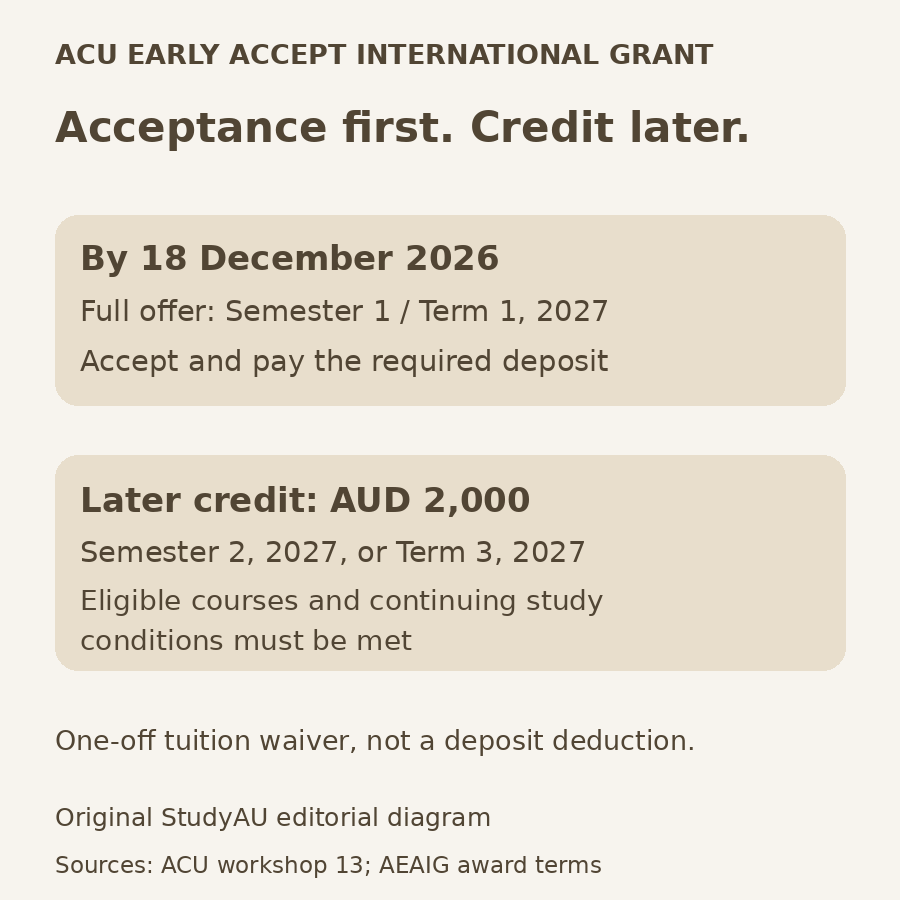
Australian Catholic University's Early Accept International Grant is a one-off AUD2,000 tuition fee waiver for eligible international students starting in Semester 1 or Term 1, 2027. To qualify, students must hold a full offer, meet the academic and English-language admission conditions, and accept and pay the required deposit by 18 December 2026.
The timing matters: the AUD2,000 is credited to the student's account in Semester 2, 2027, or Term 3, 2027 for eligible courses. It is not a cash payment or an automatic AUD2,000 reduction in the deposit due when accepting an offer.
Two stages: acceptance first, credit later
The acceptance deadline and the later credit belong to different parts of the study plan.
By 18 December 2026, the eligible applicant needs both an accepted full offer and the required deposit paid. Merely submitting an application, receiving a conditional offer or intending to accept later does not satisfy those conditions.
The grant is then conditional on continued eligible study. Students must maintain a full-time load in Semester 1 and Semester 2, 2027, or Term 1 and Term 3, 2027 where applicable, and pay required tuition fees on time. The terms also require continued enrolment in an eligible course past the Semester 2, 2027 census date.
For a term-based course, the grant confirmation needs to make the applicable enrolment and credit arrangements clear. The terms retain the Semester 2 census-date condition; they do not supply a separate date here for every term-based course.
Nationality is part of eligibility
The listed nationalities are Bhutan, Cambodia, China, Hong Kong, India, Indonesia, Kenya, Malaysia, Nepal, Nigeria, the Philippines, South Korea, Sri Lanka, Taiwan and Vietnam, plus ACU's defined Latin American and Caribbean group.
That group comprises Antigua and Barbuda, Argentina, The Bahamas, Barbados, Belize, Bolivia, Brazil, Chile, Colombia, Costa Rica, Cuba, Dominica, the Dominican Republic, Ecuador, El Salvador, Grenada, Guatemala, Guyana, Haiti, Honduras, Jamaica, Mexico, Nicaragua, Panama, Paraguay, Peru, Saint Kitts and Nevis, Saint Lucia, Saint Vincent and the Grenadines, Suriname, Trinidad and Tobago, Uruguay and Venezuela.
The university's definition matters: an applicant's language, current residence or a broad regional label should not be substituted for the nationality requirement.
Which courses and campuses are covered?
The grant applies at Australian campuses, excluding online study. Study Abroad and Exchange students are not eligible.
Course coverage includes Arts, Education and Teaching diplomas, bachelor's degrees and coursework master's degrees; Law and Business bachelor's and coursework master's degrees; and eligible Health Sciences bachelor's and coursework master's degrees. One-year honours courses are excluded.
The computing courses expressly named are Bachelor of Computer Science and Bachelor of Computer Science/Master of Data Science. The health exclusions are Bachelor of Occupational Therapy, Bachelor of Physiotherapy, Bachelor of Speech Pathology, Master of Dietetic Practice, Master of Clinical Exercise Physiology and all postgraduate psychology programs.
A course title and its level therefore matter more than the general label “international student”. A Graduate Certificate or research degree is not covered simply because it is postgraduate study. Likewise, a course starting later in 2027 should not be treated as eligible under the Semester 1 or Term 1 commencement condition.
What happens if plans change?
The grant cannot be deferred to a later semester and is not included in refund requests. It should not be treated as an amount that can be carried into a different intake or recovered as cash when withdrawing.
For budgeting, keep three figures separate: the deposit actually required, tuition charges as they fall due, and the later grant credit if all conditions are met. This avoids planning an acceptance payment around money that has not yet been credited.
The grant's conditions do not establish a general entitlement to combine it with every ACU percentage scholarship. Any combined funding arrangement needs its own confirmation; adding advertised benefits together is not a substitute for that entitlement.
Is a separate grant application needed?
No. ACU assesses eligible students automatically through the admissions process. Automatic assessment does not remove the full-offer, acceptance, deposit, course or continuing-enrolment conditions. The terms also require applicants to meet the applicable admission, visa and university compliance requirements, including sanctions screening where relevant. A grant assessment is not a government visa decision.
The useful question is therefore not just whether an applicant can meet the December deadline. It is whether the whole sequence fits: the right commencement period, an eligible course and nationality, a full offer, the required payment and continued full-time enrolment through the relevant later period.
Source: ACU's 2026 Shantou Global Engagement workshop and Early Accept International Grant terms. This summary describes the specified 2027 commencement and credit periods, not a standing grant for all future intakes.